
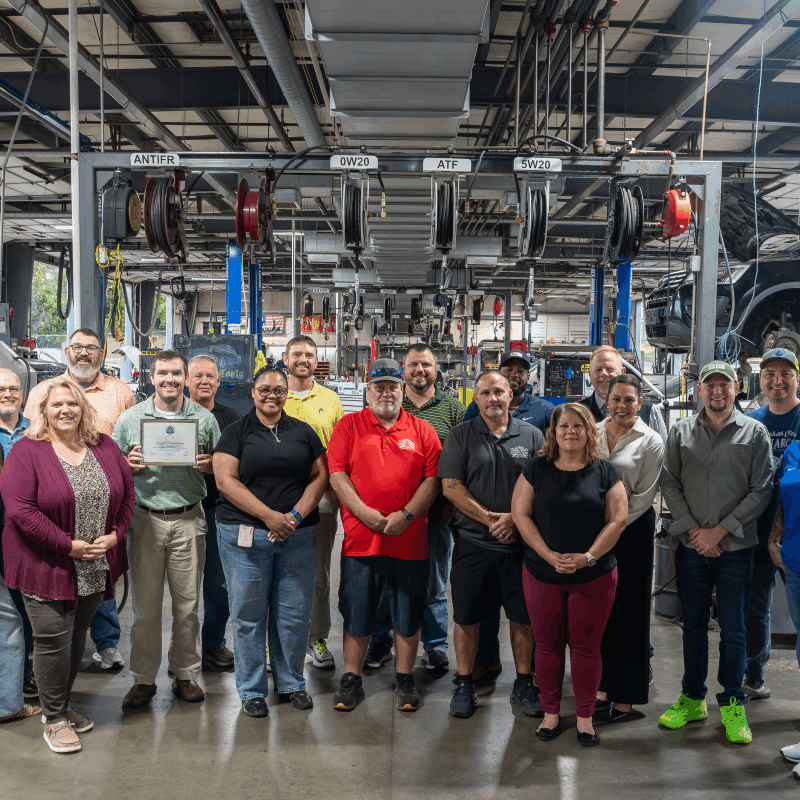
In today’s episode of Public Works Radio, the official podcast of the American Public Works Association, we’re talking all things accreditation with our guest Troy Shaw, PE, the Director of Public Works and City/County Engineer for the Unified Government of Wyandotte County, Kansas City, Kansas. We’re also joined by Jeanette Klamm, the Associate Director of Credentialing with APWA.
A structured documentation framework is essential in public works. It’s the backbone of risk management, capturing institutional knowledge, leadership continuity, community outreach, and much more. Accreditation checks the boxes on compliance with some of the most critical—literally life-sustaining—responsibilities an agency is tasked with, things you might not think about until it’s unfortunately too late.
When it comes to accreditation in public works, you might not be thinking about the cultural impact. As Troy describes, accreditation can make your team feel happier and more confident about what they do and where they work. It also builds credibility and confidence.
While the evaluation and nationally recognized practice review process formally verifies agencies for compliance with the recommended practices set forth in the Public Works Management Practices Manual, it also serves as a means for ensuring continuous self-improvement. For a public works department like Wyandotte County’s, that’s a crucial component of their culture.
Along with the boost in workplace culture, Troy has also noticed significant gains in confidence and credibility. We dive into the stories behind all those rich benefits of accreditation and what they actually mean in practice in this week’s episode of Public Works Radio.
Public Works Radio is hosted by Bailey Dickman, Senior Digital Marketing Specialist with APWA. Each episode dives into a wide range of topics designed to educate and inspire, making public works more visible to everyone—from the general public and elected officials to industry peers and the media. If you haven’t already, please subscribe wherever you get your podcasts, rate and review the show, forward it to a friend, and drop us a note at podcast@apwa.org so we can hear your feedback directly!
More Show Notes and Links
- APWA Accreditation
- APWA Accreditation questions? Send an email: accreditation@apwa.org
- Unified Government of Wyandotte County Public Works Department
Transcript
View transcript >
0:00:00.2 Troy Shaw: We always want to get better at what we do. And that’s the type of culture we’ve been trying to build for many years now. And really that’s a great opportunity to put the talk about continuous improvement into action.
0:00:11.6 Bailey Dickman: That was Troy Shaw. He’s the director of public works and city engineer for the Unified Government of Wyandotte County in Kansas. When it comes to accreditation in public works, you might not be thinking about the cultural impact. Accreditation can just generally make your team feel happier and more confident about what they do. That’s also something echoed by Jeanette Klamm. She’s the associate director of credentialing for the American Public Works Association.
0:00:34.6 Jeanette Klamm: It’s a good opportunity to kind of give some ownership to your staff because that’s theirs. It’s something that they have worked on, something that they can be proud of. And so there’s a lot of pride that goes into achieving it as a whole, as a group like that.
0:00:52.0 Bailey Dickman: Welcome back to Public Works Radio, the official voice of the American Public Works Association. Each episode dives into a wide range of topics designed to educate and inspire, making public works more visible for everyone. I’m Bailey Dickman, the senior digital marketing specialist with APWA, and in today’s episode, we are talking all things accreditation.
0:01:10.1 Jeanette Klamm: Agencies will just overthink it and so you have to reel them back a little bit and go, “Step back. Just what do you do?”
0:01:16.4 Bailey Dickman: A structured documentation framework is massive in public works. It’s the backbone of things like risk management, capturing institutional knowledge, leadership continuity, community outreach, and so much more.
0:01:27.6 Troy Shaw: The team appreciates the documentation. If they don’t know what to do, they have a place to go to figure out what to do. Have a lot of practices that are really in people’s heads. You are using this as an opportunity to get that documentation written down.
0:01:39.4 Bailey Dickman: Accreditation empowers agencies to check the box on compliance with some of the most critical life-sustaining responsibilities they have. It’s things you might not even be thinking about until it’s too late. It also builds an agency’s credibility and confidence with themselves.
0:01:52.9 Troy Shaw: It was nice to go give that speech of, “Hey, look, we’ve got this accreditation.” Most of them didn’t even know what it was. So the background on it was great for them to hear that. And then I think it kicked off things the right way and they’ve noted that they have confidence in what we do.
0:02:08.4 Bailey Dickman: Now let’s get to it. Here’s my conversation with Troy Shaw and Jeanette Klamm. What is accreditation?
0:02:15.1 Jeanette Klamm: Generally, the accreditation program is the mark of success or mark of credibility so to speak for an agency. And when I say an agency, sometimes that’s public works departments. It can also be utilities departments, fleet departments, any agency or department that offers a public works service to their residents.
0:02:38.1 Bailey Dickman: Why did Wyandotte County make this decision to get accredited in the first place?
0:02:43.1 Troy Shaw: There’s a great framework for documentation. For one, we have a lot of practices that are really in people’s heads. People have been doing it for years, so this is how we do it. No real documentation. So we were using this as an opportunity to get that documentation written down. Along with that, that helped provide stability for transitions, leadership transitions, or retirements or other things that are happening throughout our industry right now, for sure.
0:03:05.7 Jeanette Klamm: So really, what our accreditation program is based off of is documenting what you’re doing. It’s not based on doing it the right way or doing it the wrong way or doing it how I would do it or someone else would do it. It’s really based on documenting what you would do as an agency yourself. So understanding that what agencies do in California may be different than in Maine, Florida, Washington, Alaska, Canada. It’s built so that any agency across the country or Canada could do this, or really internationally for the most part, because it’s based on what the policies and procedures and the documentation that an agency has to support what they’re doing. So we have a manual that’s available. Agencies purchase the manual and go through that, and it reads like a policy for X, Y, Z, a procedure for X, Y, Z. They look at, “What are we doing and what does this manual say we should be doing or documentation we should have?” and so they may have a policy, but it’s very, very old. So they need to look at that policy and decide, “Is this still the way we do it, or is it out of date, or is it still current?”
0:04:21.6 Jeanette Klamm: And update it if they need to. Sometimes you have policies and procedures that are word of mouth that people just pass from generation to generation to generation of workers. So it’s a good thing for those to be written down because at some point in time, you’re going to lose that institutional knowledge as generation to generation goes through.
0:04:43.7 Bailey Dickman: Is that the big benefit of it, or do public works agencies have some sort of other benefit that they get from accreditation besides the documentation of “This is what we do. We told you this is what we do”.
0:04:56.1 Jeanette Klamm: Well, yeah. There’s the risk aversion because now you have it in writing. Of course. But there are lots of other benefits to an agency as well. So the succession planning. How do you capture that institutional knowledge before someone walks out the door, they’re retiring? Everybody has that 30-year employee that’s been there, they’ve done the job, they do a great job, but they’ve never written anything down because it’s all in their head. How do you capture that knowledge so that next generation of workers can be onboarded quickly and knows what’s going on and you capture what they’re doing? There’s also the credibility part of it as well. If you use it right, if you put the accreditation in the drawer and you never look at it again, that’s probably not going to benefit you a whole lot. If you splash it all over the place, you let your elected officials, let your city and county leadership know, let your residents know, there’s a whole myriad of credibility that goes with that. So that if there’s something that happens, you have something in writing to go back to the city council or to a resident and say, “Here’s our policy.” It’s a written policy, it’s been approved, we can change that policy, but at this point, this is what that policy is.
0:05:39.3 Jeanette Klamm: And so it can clear up a lot of misunderstandings, things like, “Why is my street the last one that you’re pushing snow on?” Well, here’s our plan. We’re going to do all the arterial roads first, and then we’re going to do all the side roads, and then we’re going to do residential. And so there’s your plan. So they can argue with your plan.
0:06:43.8 Bailey Dickman: At least you have it.
0:06:45.7 Jeanette Klamm: But you have it all in writing. And it’s not just you saying, “This is what we’re doing.” There’s that credibility. It helps support what the elected officials are saying and what they want. It helps support, get some credibility amongst your residents as well. It can help with budget purposes. Everybody’s fighting over the general fund. And so your police, a lot of police departments are accredited, a lot of parks departments are accredited, a lot of fire departments are accredited. It makes sense for a public works department to be accredited so that when you are putting together your budget, you have documentation that says, “This is what we’re doing, this is why we’re doing it, here’s the plan going forward, and this is what everybody else is doing as well.” So it helps support what you’re doing from a budgetary standpoint. And we even have an agency out there that had their bond rating increased specifically because of their accreditation.
0:07:47.5 Bailey Dickman: Tell me more about the Public Works Processes Manual, since the practices set forth in it are so central to the accreditation process.
0:07:53.6 Jeanette Klamm: It’s just a means of documenting what agencies are doing in various areas. The first 10 chapters are really going to be broad. They’re going to be the HR, the IT, the finance, the safety, asset management, the really broad, overarching types of chapters that all agencies, regardless of whether you’re fleet, utilities, public works, it doesn’t matter who you are, if you’re a county or city, you all have HR, you all have IT departments, you all have organizational structure-type policies and procedures. And so those are really the documentation that is for any agency to make them well-run for the most part. And then the other chapters, chapters 11 through 40, are based on what the agency offers as their authority, what they’re responsible for.
0:08:53.1 Bailey Dickman: So like, for example, if you’re in a very coastal area like Florida, you might not have something involving snow removal, exactly like we do here in Missouri?
0:09:01.3 Jeanette Klamm: Exactly. Exactly.
0:09:02.0 Bailey Dickman: When we say public works, for every community in the country, it means something different. Every public works department has different things they do or don’t cover. So accreditation kind of sounds like a, not like choose your own adventure, but like pick what puzzle pieces you need to be able to complete your picture.
0:09:20.1 Jeanette Klamm: It does. It really is made to fit whatever agency, whatever they do. Again, if you are responsible for streets and street maintenance and street cleaning, then those would be, “Yes, that’s applicable to us.” You’re in Florida, you don’t do snow and ice, then you would not do the snow and ice chapter. So yeah, you really don’t have the opportunity to say what you want to do. If it’s your responsibility, it’s your responsibility, but you go through and what is applicable to you, you would do those chapters. The ones that are not applicable to you, you just don’t do.
0:09:55.3 Bailey Dickman: While the evaluation and best practices review process formally verifies agencies for compliance with the recommended practices, it also serves as a means for ensuring continuous self-improvement. And for a public works department like Wyandotte County, it’s a crucial component of their culture.
0:10:10.4 Troy Shaw: One of the things that we really pride ourselves on in public works in Wyandotte County is continuous improvement. We always want to get better at what we do. That’s the type of culture we’ve been trying to build for many years now, and really, that’s a great opportunity to put the talk about continuous improvement into action when we have the opportunity to go through this process.
0:10:32.5 Bailey Dickman: It sounds like there’s also a real benefit to individuals at the agency getting accredited. Is that something that you see often at agencies where the employees feel like they’ve learned from the process?
0:10:46.3 Jeanette Klamm: Yeah, I think most agencies, and I think the really good agencies, include… It’s not a one-person job. Being accredited is not… It’s very difficult for one person to do. It’s a lot. So really, it makes sense to have your fleet manager do the fleet chapter, and have your streets manager do the street chapter, and have your water and wastewater superintendent do the water and wastewater chapters because they’re going to know what’s going on. They’ll be the ones… As they’re sitting there and walking through that with the evaluator, they’re able to ask questions and answer questions and kind of walk through that with them. And then as soon as they walk out of the room, they’ll know if there’s something that needs to be changed or if everything looks good or if they need to fix anything in there. During that evaluation, they can make changes and then the evaluator will re-evaluate as they go, too. So it’s a good opportunity to give some ownership to your staff because that’s theirs. It’s something that they have worked on, something that they can be proud of and it’s something that the whole group as a team… Kind of a team-building exercise, if you want to call it that. It’s really something that they’ve worked on as a group. There’s a lot of pride that goes into achieving it as a whole, as a group like that.
0:12:07.7 Troy Shaw: One of the big things we got was we had the three reviewers coming to town from other agencies. One thing that they noted, which I’m probably the most proud of, is the culture. They noticed, all three of them mentioned, the culture we have around public works, the way we work together. It doesn’t mean we’re all best friends by any means, but it means we’re all here to do a job and we all respect each other and work very well together. And I think noting that means a lot to me. What we’ve tried to do with public works over the last 10 years is develop a culture where everybody’s included and we try to build leadership at all levels. So that was one of the real big things.
0:12:53.4 Bailey Dickman: Along with the boost in workplace morale, Troy has also noticed significant gains in confidence and credibility.
0:12:59.8 Troy Shaw: We recently just had a lot of change in our new mayor, three new commissioners. It happened at a perfect time for us to become accredited. It was nice to go give that speech of, “Hey, look, we got this accreditation.” Most of them didn’t even know what it was, the background on it was great for them to hear that. And then it kicked off things the right way and they’ve noted that they have confidence in what we do. I don’t know if that’s just because they would have said it either way, but I think having that accreditation behind us adds a little value to the confidence that other people have in what we do. From our staff perspective, I think this is one of the things that I’ve really liked about accreditation is that the team appreciates documentation, especially the newer employees. If they don’t know what to do, they have a place to go to figure out what to do. If they’re here and their supervisor’s not here, they have something to go to to figure out how they’re supposed to be doing it.
0:13:59.5 Troy Shaw: One of the things that we got out of accreditation is a lot of our team members feel like their voices are heard. They feel more confident in what they do. When we went through this process, we wanted everybody included. We didn’t just want three people sitting down in a room writing all these practices and then handing them out to people. Our goal was to include everybody we could in the decisions and the conversations related to it. And I think that’s really led to the team member feeling valued and confident in what they’re doing on a day-to-day basis because they know they helped develop those practices, put them in writing, and then will also be able to bring up suggestions going forward if they think there’s ways to improve.
0:14:45.3 Bailey Dickman: I want to circle back to that “communication with residents” part. Those types of community outreach or just best practices for communities, are those also included within accreditation?
0:15:00.5 Jeanette Klamm: Yeah. So we have what we call a model practice library. As I said, when our evaluators come in and do their evaluation, they’re not looking at, “Is this a good practice, a bad practice, what my agency would do?” They’re looking at, “Do you document what you do?” If it works for you, that’s great. Do you document it? And so having said that, they’re also reading through documents, they’re reading through policies and procedures. And so from time to time, they’ll run across one where they’re like, “Wow, this is really well written. This is something that any agency across the country or Canada could pick up and get a really good idea of what’s expected for this particular practice.” So when they find those, we ask the agency if we can use those in our model practice library. That model practice library is made available for any agency that is accredited or an applicant, someone who’s committed to getting accredited. Because it’s agency documents, we want to keep a little bit of security on it. And so once they’ve put their application in and become an applicant or an accredited agency, they have access to our 800 and some odd something model practices that are out there.
0:16:14.9 Jeanette Klamm: So not every single practice has a model practice, but there are a lot out there and some have multiples. So if you’re like, “I wonder what everyone else is doing for an asset management policy,” you can go in there and look at… And I just happen to know that asset management policies, there’s like 10 of them in there. So they can go in and look at what other agencies are doing and then kind of formulate how they want to put their policy together based on what other people are doing.
0:16:41.6 Bailey Dickman: It’s kinda… Like it’s both getting your own house in order basically, but also seeing what’s the best of the best from around the country from every other public works agency that I don’t necessarily always have contact with or I don’t know anybody at, but at least I can take a little peek at some of their documentation.
0:17:00.5 Jeanette Klamm: Sure. Yeah, that’s a great opportunity. And even agencies that have been accredited for a long time, part of the program is continuous improvement. So you’re going back and looking at your documents, even if it’s just to review it and go, “Yep, we’re still doing this the same way, this is still accurate.” Or maybe it’s, “You know what, there’s got to be a better way to do this.” And then there’s an opportunity for them to go out and take a look at what other people are doing as well.
0:17:26.8 Bailey Dickman: And once an agency is accredited, they’re not just… You can’t just set it and forget it for 10 years, 20 years.
0:17:33.1 Jeanette Klamm: Correct.
0:17:33.6 Bailey Dickman: You have to go through a reaccreditation process. Can you talk a little bit about that?
0:17:37.5 Jeanette Klamm: So the milestones of accreditation so to speak would be that you send your application in. So that lets us know that you’re committed to accreditation. You’re starting the process, you’re going through the self-assessment, you’re comparing what’s in the manual to what you’re doing, and you’re getting ready for that initial accreditation. Once you send the application in, you have three years, and normally that’s more than enough for agencies to get ready to go for that initial evaluation there. Most agencies take 18 months to two years. So three years is plenty of time for most agencies. Once they get that initial accreditation, then that’s good for four years. And then every four years after that, we do a reaccreditation evaluation. And some of those can be virtual. We do a random one-third. It’s not as intense as that initial one, but every four years we do a reaccreditation assessment for them.
0:18:33.9 Bailey Dickman: Was there anything about accreditation that surprised you when you decided to go through the whole process? Was there anything that stood out to you or shocked you?
0:18:44.3 Troy Shaw: I think getting the book right at the beginning and seeing all the different practices and…
0:18:48.9 Bailey Dickman: It’s a gigantic book.
0:18:50.5 Troy Shaw: Yes. It seems very overwhelming when you get that. I think that was probably the first surprise. But once you sit down and go through it and figure out the plan of action, that was okay. A couple of things that surprised me most about going through the process was the discussions that were had amongst the team. You don’t always get that feedback from every level sitting in a room. So from your top of your leadership to the person that was just hired to do the entry-level position, the ability to sit down and have those discussions together and the in-depth review of why we do something, having that open and honest conversation about what we’re missing, why we’re doing things the way we do it, and should we do it differently than the way we’re doing it. I think that was one of the things that surprised me, is the willingness of everybody to have that discussion and how that all flowed together and worked well. Kind of related to that is the ownership that the team members took in each practice that they worked on.
0:19:50.6 Troy Shaw: I think a lot of the history was kind of, “Well, we go out there, we get this job done, and we go home.” Now, I think there’s a lot of thought into, “We’re going out, we did this job, but how do we do it better next time?” so when someone goes out and does something, I think it’s because they were involved in the practices they worked on. Even if it’s patching a pothole on a road, it’s like, “Alright, we did this, we followed the practice, but is there a better way to do this as we’re working through this?” If there is, let’s note it, document it, and start updating our practices so that we keep up with the times. That was one of the things that I’ve been surprised by, just the way the team’s been working.
0:20:27.2 Bailey Dickman: Was there any specific practice or specific kind of recommended SOP that really surprised you? In that big book, there’s a million different practices to choose from. What does your agency handle? What was one that surprised you the most?
0:20:44.7 Troy Shaw: I think the ones that got me the most were… I don’t remember what the first nine or ten chapters… I forgot how many there are that you have to do, are required by every agency. The amount of stuff in those chapters that we need input and help from through the rest of our organization. Public works, and I think a lot of public works organizations are like this, we take a lot of pride in, “You want it done, we’ll get it done, we’ll figure out a way to get it done.” But then there are a lot of things that we just can’t truly control ourselves. The understanding of needing to work with everybody else and build those relationships with the other departments I think was surprising to me about how much APWA had noted that and sees how important that is. And it’s kind of one of those things that you don’t really think about until you need something. But having to go through those practices with other departments and get that information, I think was a huge benefit, but also surprising that we needed to do all that and appreciate that APWA actually thought about that.
0:21:53.5 Bailey Dickman: Nobody ever wants to think about the HR or the IT part of it until something goes wrong and then you’re like, “Oh no, now I need to think about HR or IT or communications” or whatever it is, yeah. This might be mean to throw on you, but what’s your favorite kind of out-of-left-field things that are in the accreditation manual that the normal person wouldn’t think of when they think of public works?
0:22:21.0 Jeanette Klamm: Well, the one that I think is the funniest, sort of funniest in kind of a bizarre sort of way, and the one that I find a lot… I’ll say a lot, not most, evaluators like to do this one or like to read this one is the dead animal removal. Because it’s its own practice and it’s what is your policy or what is your procedure for removing dead animals? When somebody runs into a deer and it’s laying in the middle of the highway, what do you do?
0:22:54.5 Jeanette Klamm: What do you do? What is your policy? What’s your procedure? And it can be a very simple policy and procedure. It doesn’t have to be real complicated. But if you don’t have a policy and procedure, how does anybody know what they’re doing?
0:23:03.5 Bailey Dickman: You’re like, “Who takes care of that?”
0:23:05.7 Jeanette Klamm: Who takes care of that?
0:23:07.5 Bailey Dickman: I guess we do kind of, or maybe it isn’t our job. Maybe our job is to…
0:23:09.8 Jeanette Klamm: And how do you deal with it? Okay, we’ll go pick it up. Now what do we do?
0:23:11.0 Bailey Dickman: Now what? What’s step two?
0:23:13.6 Jeanette Klamm: But that’s usually one of the more favorites of the practices.
[laughter]
0:23:19.9 Bailey Dickman: I love that one. What are some of the comments that you hear from agencies going through the accreditation process?
0:23:25.6 Jeanette Klamm: Everything from, “We thought we had a policy on this and we know we did somewhere, but we can’t find it,” to, “Yeah, we’ve always had a policy on that, no one’s ever written it down,” to, “Gosh, that’s something we never thought about,” or not even knowing who’s supposed to be doing it. I think the one thing that I probably, from a recommendation standpoint to agencies, is don’t overthink it. Sometimes when agencies are going through the process of getting all their documentation put together, they feel like they have to write a book. You don’t have to write a book. Just be very specific on what you’re doing. And that may be just a couple paragraphs and that’s perfectly fine. Same thing with your policy and your procedure, it doesn’t have to be pages upon pages. It can be a one-page policy and that’s fine. But sometimes agencies will just overthink it. And so you kind of have to reel them back a little bit and go, “You know what, step back. Just what do you do?”
0:24:25.8 Bailey Dickman: Just tell me what you do.
0:24:26.8 Jeanette Klamm: “How do you handle this?” Somebody calls in and they have a complaint about X, Y, Z. How do you do this? And most of the time it’s just, “Oh, well, we do this and this and this.” Okay, write it down.
0:24:38.8 Bailey Dickman: That’s it. That’s all you need to do.
0:24:40.5 Jeanette Klamm: Perfect. That’s perfect. Yeah.
0:24:41.3 Bailey Dickman: Do communities notice when their public works agency gets accredited?
0:24:48.1 Jeanette Klamm: It’s not a difference between, “Oh, wow, a year ago they were really bad, and all of a sudden they’re really, really good.” I don’t think it’s so much like that. I think it’s the fact that you have policies and procedures in place so that if someone has a question on, “Why are you doing something the way you’re doing it?” Well, our policy is, or our plan is, or our process is to do it this way. You have something to back up what you’re doing. It’s not just the manager deciding how they’re going to do it that day, and tomorrow’s a different day and they’re going to do it a different way. So I think there’s that consistency. Everybody knows they’re going to clean the arterial roads first and the secondary roads second, and then they’re going to get to the… There’s a way that they’re going to do things and it’s consistent across the board. I think that’s probably the noticeable part of it, as noticeable as public works is. Nobody ever notices things until things go wrong, and then that’s when people notice it. So it’s hard to say that people will notice the outstanding part of it.
0:25:58.9 Troy Shaw: How it set up the team and the ability to do it. I know you could probably sit down, and maybe some people have, sit down and have three people sitting in a room writing all these practices, going through everything, putting it down, and then distribute it out to the team as the “Hey, here’s what you need to do to make sure we’re doing it the right way.” But accreditation is a great opportunity for teams to work together. In our public works organization, we have anywhere between 250 and 300 people, depending on where we’re at with hiring. The ability to have almost everyone sitting in a room working on something at one point or another, a different practice, I think really helped build our team and gave the team a lot of confidence and empowered them to think about what they can do to improve going forward. One thing we did have with our teams is that open conversation I think was a huge benefit. The accreditation process is a great opportunity to instill that and empower your team to take ownership of the stuff they do every day.
0:27:11.7 Bailey Dickman: Thank you for listening to Public Works Radio, the official voice of the American Public Works Association. And thank you to today’s guests, Troy Shaw and Jeanette Klamm. Make sure to subscribe wherever you get your favorite podcast, rate it, review it, and forward it along to a friend. Don’t be shy about dropping us a note over at podcast@apwa.org so we can hear your feedback directly. We’ll catch you next time.
Proficiency Levels
Introductory
Focuses on a general or broad overview of the topic, awareness of basic factual recall. Limited experience of the subject matter is necessary to understand content areas.
Applied
Focuses on practical implementation of technical steps or strategies, some prior knowledge and experience of the topic is necessary.
Advanced
Mastery of basic concepts associated with an area has been obtained. Focuses on understanding nuances, advanced concepts, and intricacies with implementation within knowledge area. Strong understanding of how the concept impacts other factors or areas of operations.
Program Types
CLL
Click, Listen & Learn (CLL) are interactive educational webinars. Each program is led by top experts in the field who share new ideas, methods, and technologies in a fast-paced two-hour time frame. These programs are available free to APWA members. CLL programs are eligible for continuing education units (CEUs).
Primer
Primers are used to educate policymakers about public works roles and responsibilities in public rights of way, the impact of federal workforce development policies on the industry and workforce, and the importance of resilient infrastructure.
Public Works Radio Podcast
Public Works Radio is the official podcast of the American Public Works Association (APWA), bringing the stories behind our communities to life. This podcast shines a spotlight on the people and projects that keep our cities running—humanizing the work and the professionals who make it happen. Each episode dives into a wide range of topics designed to educate and inspire, making public works more visible to everyone.
PWX
PWX session recordings cover a wide variety of topics, including integrating modes of transportation, traffic and transit, construction management, emergency management, engineering and technology, fleet and facilities, management, parks and grounds, snow and ice control, and stormwater/flood control, as well as solid waste, roads and bridges and water/wastewater. PWX sessions are eligible for continuing education units (CEUs).
Reporter Articles
APWA Reporter articles are written by public works practitioners on subjects such as solid waste management, water resources, municipal engineering, transportation, equipment services, buildings and grounds, snow removal, and other public works-related topics.
Snow
The Snow Conference session recordings feature public works professionals sharing the latest best practices in managing winter/snow operations more successfully, taking advantage of emerging technologies, understanding and preparing for the challenges ahead, and providing better service to their communities. Snow sessions are eligible for continuing education units (CEUs).
Tech Boxes
A tech box is a PDF take-away that provides information in lists, steps, or defined areas specifically focused on trending technologies.
Virtual Program
Virtual programs are live, interactive educational programs led by top experts in the field who provide timely information or address trending topics within an area. Programs often conclude with an open forum for Q&A.