
Understanding and Managing Shared Public Space
Managing the right-of-way (ROW) is a complex task that extends beyond what is visible on the surface. It requires careful coordination of transportation systems, permitting processes, ongoing maintenance, and the many utilities that lie underground and overhead. Public works professionals must also balance the needs and safety of community residents, utility providers, maintenance workers, and construction crews—all while navigating regulations and minimizing disruptions to the public. This infographic offers a visual introduction to the ROW and the various elements it encompasses, highlighting the systems that make up and move through this critical public space. The infographic is accompanied by overviews of key areas of ROW management, along with links to educational resources and further information on each topic.
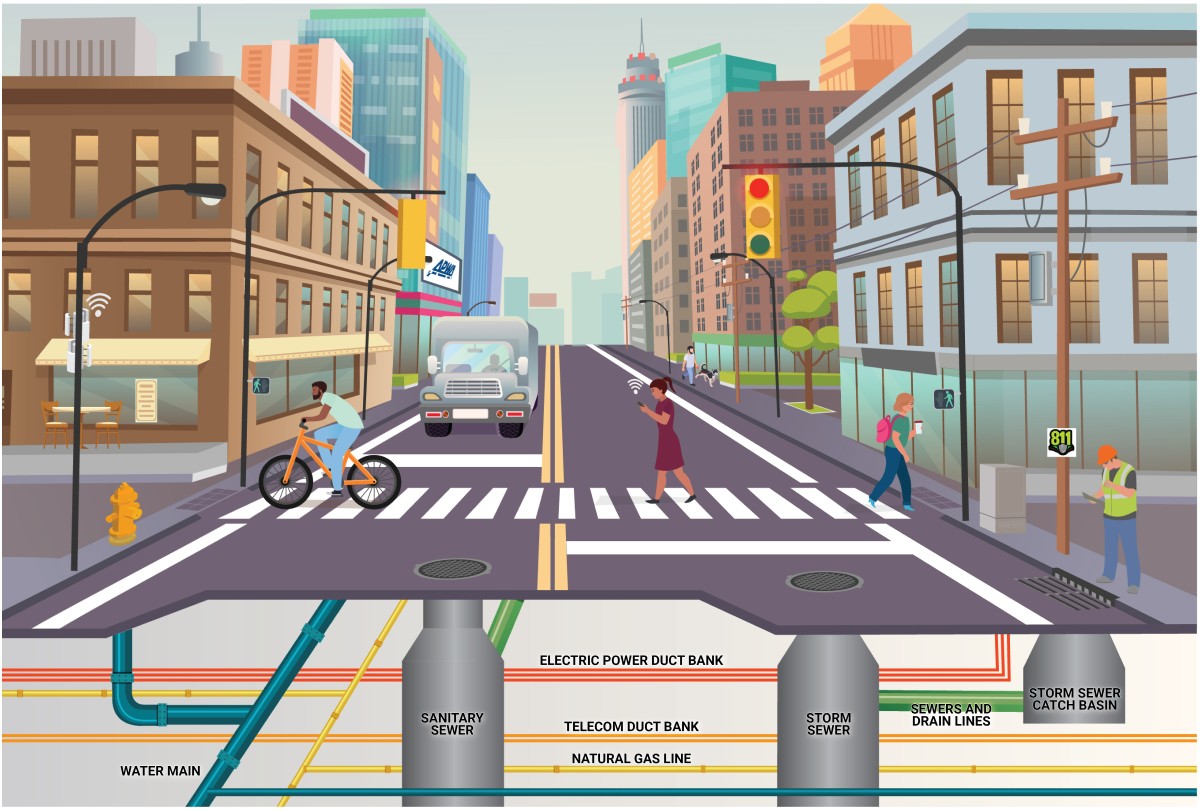
Public ROWs are critical corridors not only for transportation but also for the placement and operation of essential utility infrastructure. These spaces often accommodate a wide range of public and private utilities, including electricity, water, gas, sewer, stormwater drainage, and communications systems such as telephone, cable, and broadband internet.
Utilities within the ROW may be owned and operated by public agencies, private companies, or a combination of both. Their presence is essential to delivering basic services to homes, businesses, and institutions, but also adds layers of complexity to the planning, permitting, coordination, and maintenance of the ROW.
Proper management of utility installations requires careful consideration of safety, accessibility, long-term infrastructure needs, and minimizing conflicts between users. Public works professionals play a key role in overseeing this coordination, ensuring utility work complies with local codes, design standards, and permitting requirements.
Below are educational resources designed to help public works professionals in understanding, managing, and regulating utility use in the ROW.
- APWA Uniform Color Code
- APWA Guidance “Permanently Marking Buried Utility Lines”
- APWA Guide “Locating & Marking of Abandoned and Inactive Utility Facilities”
New technologies for deploying utilities such as broadband, small cell infrastructure, and others have significantly impacted how ROWs are managed, introducing new challenges and added complexity to utility coordination and oversight.
Below are some resources to help navigate these evolving practices, including guidance on fiber installation, microtrenching, and 5G/small cell deployment:
- When Fiber Comes to Town Toolbox
- APWA Click, Listen & Learn webinar featuring A Municipal Perspective on Managing Microtrenching in the Right-of-Way
- APWA 5G/Small Cell State of the Technology Tech Box
ROW permitting provides legal authorization for activities that go beyond the standard public use such as walking, biking, or driving within a public ROW or easement. These permits allow individuals, contractors, utility companies, or agencies to access, use and perform work within the ROW while ensuring that all work is performed safely and in compliance with local codes, standards, and regulations.
Common permitted activities include:
- Installation, repair, or maintenance of utilities
- Construction activities such as sidewalk or road work
- Temporary street closures or lane shifts
- Special events that use public streets or sidewalks
- Commercial uses such as outdoor dining, signage, or vending within the ROW
Public works agencies are typically responsible for reviewing permit applications, setting conditions for approval, and enforcing compliance with those permit requirements throughout the duration of the activity.
In addition to obtaining the necessary ROW permits through the public works agency, contacting 811 before beginning any excavation is a critical safety requirement. Calling 811 ensures that underground utilities such as gas, water, electricity, and communications are properly located and marked before digging begins. Including 811 verification as part of the permitting and inspection process helps to prevent utility damage, protect public safety, and ensure compliance with local and state regulations.
Effective management of utility cuts within the ROW is essential to maintaining roadway integrity, ensuring public safety, and coordinating with utility providers. Find updated guidance on utility cuts in the APWA Toolbox “Managing Utility Cuts.”
Public ROWs serve multiple modes of transportation, including automobiles, mass transit, bicycles, and pedestrians. To ensure accessibility and safety for all users, jurisdictions must follow established guidelines and standards for each mode. This includes proper planning and maintenance of traffic control devices, pavement markings, signage, and street or highway design.
Below are resources related to transportation responsibilities within the ROW, including policies and standards for traffic operations and geometric roadway design and accessibility:
- Federal Highway Administration’s Manual on Uniform Traffic Control Devices (MUTCD)
- These APWA Click, Listen & Learn webinars discuss the updates to the MUTCD
- The American Association of State Highway and Transportation Officials (AASHTO) Policy on Geometric Design of Highways and Streets ("Green Book”) has been adopted as the official design standard for projects on the National Highway System (NHS). Federal law requires that these design standards be approved by the US Department of Transportation in cooperation with state highway departments.
- This APWA Click, Listen & Learn webinar discusses the AASHTO Transportation “Green Book” and the use of updated design guidance and design flexibility throughout the document.
- US Access Board’s Public Right-of-Way Accessibility Guidelines
Roadways and other assets require maintenance and replacement periodically. Agencies can provide standards, specifications, and best practices for performing inspections, preventive maintenance, and accessing assets for replacement or repair (e.g. street cuts). For federal guidance on installation and future maintenance access, visit Utility Relocation and Accommodation on Federal-Aid Highway Projects. For local guidance on installation and future maintenance, consult your local authority.
There are numerous assets that exist within the ROW that require regular operation and maintenance such as streets, sidewalks, curbs, signs, trees, landscaping, streetlights, etc. It’s important for agencies to implement an asset management system. These systems help track the location, condition, ownership, and maintenance assets. APWA’s Asset Management Committee has created an Asset Management Roadmap to help agencies build an effective and comprehensive asset management program.
ROW management must account for regulations and coordination across local, state, and federal government agencies to ensure compliance, safety, and effective use of public infrastructure. APWA Government Affairs, in collaboration with the Utilities and Public Rights-of-Way Committee, provides education for policymakers on issues affecting utility coordination and ROW management. Visit APWA’s Policymaker Primer, Public Works and ROW Management.
Effective ROW management involves taking responsibility for the health, safety, and welfare of all users. All users of the ROW have an obligation to follow applicable laws and standards relating to safety. Additionally, public works agencies should foster a culture of safety and encourage their teams to implement proactive safety measures and communicate concerns in a timely manner.
Clearances for pedestrians, ADA accessibility, operational safety and efficiency, industry standards, and regulatory requirements must all be maintained within the ROW, a focus supported by APWA’s participation in the AASHTO Committee on Safety (COS).
Public works agencies must also consider the safety and security of the ROW when it comes to community-driven uses such as memorials in the ROW. The APWA Utilities and Public Right-of-Way Committee hosted the “Memorials in the Right-of-Way” webinar that explored how an agency creates a policy for memorials in the ROW and how to balance safety, aesthetics, and cultural beliefs in areas designed for use by all.
The Utilities and Public Rights-of-Way Committee collaborates with the Common Ground Alliance (CGA) through working committees on topics like best practices and damage prevention. The CGA has a tool (DIRT) for submitting data about underground facility damages and near-miss incidents due to excavation activities.