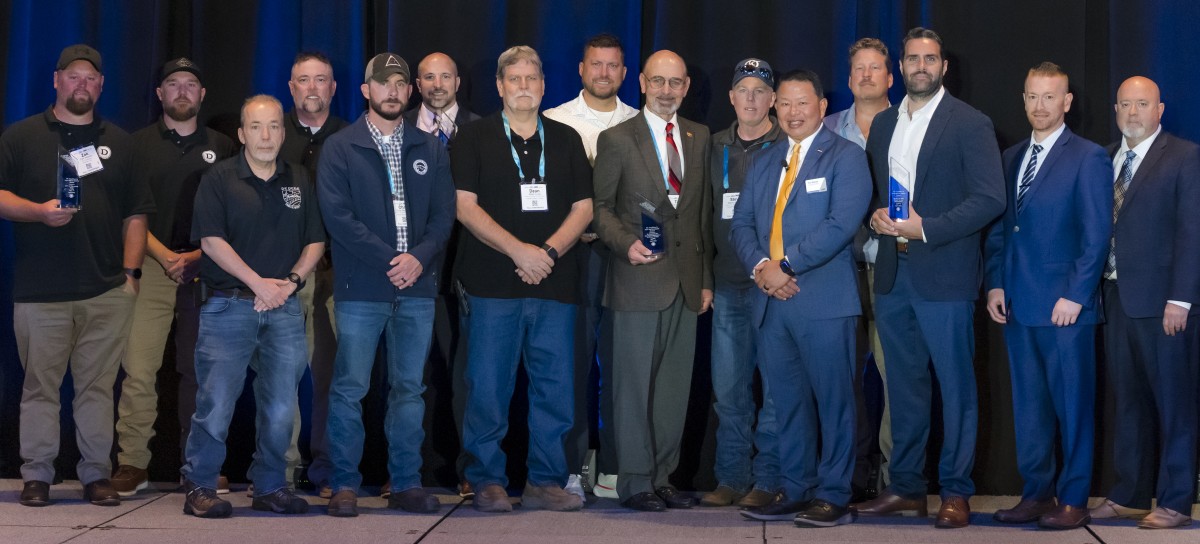
Winners of the 2026 Excellence in Snow and Ice Control Award receive their awards during the Opening General Session at the North American Snow Conference in Cleveland, Ohio.
FOR IMMEDIATE RELEASE
KANSAS CITY, MO–Seven public works agencies have been selected to receive the American Public Works Association (APWA) 2026 Excellence in Snow and Ice Control Award. APWA established this award to promote excellence in the management and administration of public works snow and ice operations and to promote the best practices in snow and ice removal while minimizing environmental impacts. This year’s winners were honored on April 27 during the Opening General Session at the North American Snow Conference (NASC) in Cleveland, Ohio.
“Honoring the Excellence in Snow and Ice Control Award winners each year is always a point of pride,” said APWA President Vic Bianes, PE. “Effective winter maintenance is about far more than clearing roads and sidewalks—it requires months of planning, preparation, and commitment to public safety. Time and again, these award‑winning agencies demonstrate their ability to meet every challenge, whether facing modest snowfall or major winter storms.”
The 2026 APWA Excellence in Snow and Ice Control Award recipients are:
El Paso County, Colorado Department of Public Works
El Paso County maintains 4,400 lane miles across challenging terrain and has about 24 plowable snow events annually. Its winter program emphasizes preparedness, precision, and environmental protection, clearing more than one million lane miles each year. Materials—including salt, sand, brine, and magnesium chloride—are stored in protective containment, and application rates are standardized for efficiency. Its fleet of 40 plow trucks, 22 graders, and liquid-application vehicles is equipped with telematics that support real-time oversight. The county’s 140 snowfighters receive extensive training, and a public dashboard provides real-time updates on plow progress to support transparency. Environmental stewardship is also central, with stormwater upgrades, spill prevention, and chloride-reduction strategies guiding operations.
Village of Niles, Illinois Public Works Department
Over the past five years, the Village of Niles has strengthened its snow and ice program through major investments in infrastructure, equipment, technology, and training. A $6.5 million campus redesign increased salt storage by 190 percent and liquid storage by 42 percent. Fleet upgrades added 13 new pieces of equipment, including snow blowers, trucks, and swap loaders that cut equipment changeout times from hours to minutes. Technology enhancements include mobile and fixed Road Weather Information System (RWIS) units, upgraded GPS/AVL, and computerized salting controls. Training includes in-house instruction, regional workshops, simulator-based training, and municipal peer guidance. Public outreach campaigns have earned nearly one million views and national recognition.
City of De Pere, Wisconsin Department of Public Works
The City of De Pere serves 25,600 residents with a small team responsible for 120 centerline miles and an average of 46 inches of snow annually. The city maintains extensive material capacity, including a 1,100-ton salt dome, a 780-ton shed, and brine production systems capable of 6,000 gallons per hour. Fleet upgrades include plows, graders, loaders, and a new tandem plow with a dual-auger spreader that improves efficiency and reduces salt use. Dash cameras integrated with automatic vehicle location systems provide real-time snapshots of road conditions. Training includes statewide workshops, dry-runs, simulation, and public outreach events. Operations focus on calibrated material use and proactive anti-icing up to three days before storms.
City of Leawood, Kansas Public Works Department
Leawood serves 34,000 residents and manages 400 lane miles through a coordinated winter response. Two major salt facilities store 5,000 and 2,500 tons, with five liquid tanks holding brine and calcium chloride. Fleet upgrades include wing plows, blade-saver hydraulics, traction chains, heated mirrors, and swap-loader systems, supported by two 2,000-gallon spray units and heated storage bays. Employees receive APWA-certified winter training with standardized manuals and the 2025–2026 Winter Snow Book. Community engagement includes social media, brochures, school plow-painting contests, and a dedicated snow webpage with real-time updates. Technology includes material-use logs, alternative chemicals, and corrosion-inhibitor strategies.
City of Delaware, Ohio Public Works Department
The City of Delaware manages 200 miles of roadway and has transformed its winter operations through major modernization efforts. Automated brine production now creates high-quality blends that improve roadway performance while reducing salt use. Fleet and equipment upgrades—such as loader scales, precise spreader controls, calibration programs, and custom brine trucks—enhance accuracy and minimize waste. Training includes dry-runs, blind-spot awareness, brine chemistry, GPS routing, and multi-jurisdiction coordination. The city also prioritizes community engagement through social media, ride-alongs, mobile apps, and live radio updates. Technology enhancements include pavement sensors, smart cameras, and advanced forecasting, while environmentally focused efforts emphasize salt reduction and sustainable equipment retrofits.
City of Columbus, Ohio Department of Public Service
Columbus manages 4,700 lane miles and averages 27 inches of snow annually while modernizing its winter operations. The city maintains more than 34,000 tons of salt and 280,000 gallons of liquid deicer, producing brine at four outposts with a combined capacity of 16,000 gallons per hour. Fleet upgrades include direct-cast spreaders, bike-lane equipment, expanded anti-icing units, and multi-use flusher/anti-icer trucks. Dynamic spreading has reduced salt use by up to 40 percent. Technology improvements include road-condition sensors, vehicle tracking, and a driver app for routing and material tracking. Regional partnerships and robust public communication support strong community engagement.
City of Oak Creek, Wisconsin Department of Public Works
Oak Creek supports more than 25,000 residents with an environmentally responsible, data-driven winter maintenance program. Salt is stored in a fully covered shed, and 31,250 gallons of liquid deicer are maintained within a protective containment system. The fleet includes 26 modern units with segmented blades, ground-speed controllers, and pavement temperature sensors. Preseason and post-event calibrations ensure accuracy. Training includes route inspections, equipment operation, and Wisconsin Salt Wise environmental training. Outreach includes a snow-information webpage, social media, Story Time with a Snowplow, and community events.
To learn more about this year’s Excellence in Snow and Ice Control Award recipients, read an article in the April issue of APWA Reporter.
For more information about the APWA awards program, please contact APWA Chapter Services Manager Cameron Harmeyer at charmeyer@apwa.org or by phone at (816) 595-5259. To learn more about NASC, visit the conference webpage.
About APWA
The American Public Works Association (www.apwa.org) is a not-for-profit, international organization of more than 30,000 members involved in the field of public works. APWA serves its members by promoting professional excellence and public awareness through education, advocacy, and the exchange of knowledge. APWA is headquartered in Kansas City, Missouri, has an office in Washington, DC, and 62 chapters and 97 branches throughout North America.
Jared Shilhanek
Chief Growth Officer
(816) 595-5257
jshilhanek@apwa.org