
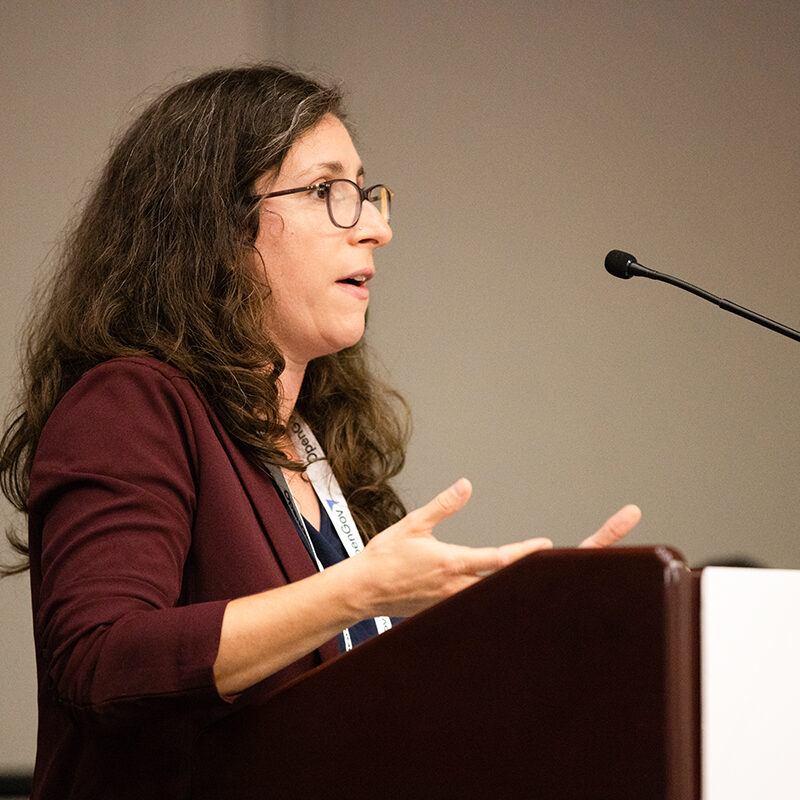
While it may be true there are more women in public works than there used to be, deeper questions still remain.
This week on Public Works Radio, the official voice of the American Public Works Association (APWA), we’re joined by two individuals whose decades of passion for this line of work serve as inspiration to the next generation of young women ready to break into this field and lead it forward: Roby Whitehouse and Shannon Williams, PE.
Roby is the Assistant Public Works Director in Yarmouth, Massachusetts, a town she’s been serving for nearly 30 years. For Roby, leadership didn’t come from a single, predictable path. It came from years of hands-on experience across several areas of public works, including cemeteries, facilities, highway, parks, and waste management.
Shannon serves as Principal Engineer for Keller Associates in Salem, Oregon. She’s worked in some form or fashion related to public works for 27 years. During this time, managing projects in everything from roads and bridges to dams and levees, wastewater/stormwater, and hazmat, she’s learned a lot about asserting herself and owning her work.
Join us for a vibrant conversation with two respected public works professionals who just happen to be women. They’ll share how they got here, the challenges of working in a male-dominated field, nontraditional paths to leadership, and what changes when the workforce starts to look a little bit more like the communities it serves.
Public Works Radio is hosted by Bailey Dickman, Senior Digital Marketing Specialist with APWA. Each episode dives into a wide range of topics designed to educate and inspire, making public works more visible to everyone, from the general public and elected officials to industry peers and the media. If you haven’t already, please subscribe wherever you get your podcasts, rate and review the show, forward it to a friend, and drop us a note at podcast@apwa.org so we can hear your feedback directly!
More Show Notes and Resources
- APWA’s Workforce Development Committee
- CareerZone’s Career Paths tools and resources
- Roby Whitehouse on LinkedIn
- Shannon Williams, PE, on LinkedIn
Transcript
View transcript >
0:00:00.0 Shannon Williams: I mean, I still have sat down at a conference table and had someone say, “Oh, honey, can you get me coffee?”
0:00:04.4 Bailey Dickman: Mmhm. Ouch, ouch.
0:00:08.7 Shannon Williams: And I’m like, “Oh, okay. I mean, sure, I can get you coffee.” Or the assumption that a woman who’s sitting around the table is just there to take notes. And I would think that it has changed, but it doesn’t always change. And I think every little place has its own assumptions about women in public works.
0:00:27.1 Bailey Dickman: That was Shannon Williams. She serves as principal engineer for Keller Associates in Salem, Oregon. She’s worked in some form or fashion in public works for 27 years. And in that time, while managing projects in everything from roads and bridges to dams and levees, wastewater, stormwater, hazmat, she’s learned a lot about asserting herself and owning her worth.
0:00:46.7 Shannon Williams: So I think there’s times when I feel, especially very early on in my career, where I felt like I had to prove things. And at this point, I just remind myself that I’m supposed to be there, like I’m supposed to be in that table. I’m supposed to be around the room. My voice matters. Learning to advocate for myself, ’cause there isn’t always someone that’s gonna do it for you.
0:01:07.6 Bailey Dickman: And while it may be true that there are more women in public works than there were when Shannon first entered the field, we still have questions.
0:01:14.4 Shannon Williams: I think my biggest frustration is when folks are like, “Well, it’s better.” And it’s like, is it really? Yeah, there’s more women but are they sitting around the table?
0:01:25.1 Bailey Dickman: To further address this issue, Roby Whitehouse is conducting a series on advancing women in public works with APWA’s Workforce Development Committee. Roby is the assistant public works director in Yarmouth, Massachusetts, a town she’s been serving for nearly 30 years.
0:01:38.5 Roby Whitehouse: Really trying to encourage everyone who is a woman in public works, no matter whether they’re a director or an assistant director or a supervisor or a truck driver or a frontline worker, whatever, we want everybody to have a voice in the conversation and encourage women to participate in public works. So we’re trying to do series of not only introducing ourselves and building a network of communication and teamwork, but also educating each other on how we can advance, where we can encourage other women, how we can mentor, how we can become champions to other women. And it’s really taken off.
0:02:19.8 Bailey Dickman: For Roby, leadership didn’t come from a single predictable path. It came from years of hands-on experience across several areas in public works, including cemetery, facilities, highways, parks and waste management.
0:02:30.5 Roby Whitehouse: The more people that come in and drink the Kool-Aid, so to speak, and understand that public works is an amazing career, the more people will understand that they can move up the ladder, so to speak. We all start somewhere. There may be some people who come from leadership on the private side or have their engineering degree, but that does not necessarily mean to be the only trajectory to leadership.
0:02:55.7 Bailey Dickman: Welcome back to Public Works Radio, the official voice of the American Public Works Association. This week we’re talking women in public works: how they got here, the challenges of working in a male-dominated field, non-traditional paths to leadership and what changes when the workforce starts to look a bit more like the communities it serves. I’m joined by two people who have lived it for decades, Roby Whitehouse and Shannon Williams. Their stories serve as inspiration to the next generation of young women who are ready to break into this field and lead it forward. Now, let’s get into it. First up, I was curious about what drew both Shannon and Roby into public works. Roby’s three decades of service in Yarmouth actually started out in finance, but when she got snubbed for growth opportunities there, it was public works that had her back.
0:03:36.4 Roby Whitehouse: There was one opportunity for a step up and I was exceptionally qualified and they didn’t hire me from within. So I marched down the hall to the then DPW director and said, “You have an opening. I want it. What do I need to do?” And he said, “You got it.” He had experienced me working in the finance department. He knew I was solid. He knew I was someone of integrity. We had a mutual respect for each other and it was a natural transition. I would say he was probably my first mentor in public works that kind of pushed me through the paces and said, “Hey, you’re gonna take facilities, you’re gonna take cemetery, you’re gonna do this and you’re gonna learn it all.”
0:04:17.7 Bailey Dickman: What drew Shannon to the public works side of things was an incredibly satisfying rush that many professional engineers don’t necessarily get to see. And that’s the firsthand impact of the work they do in their own communities.
0:04:28.5 Shannon Williams: I have always really liked seeing the impact that the projects that I work on have on the communities that I get to work with. I worked for much larger firms before coming to Keller and I got to work on some really fun high-profile projects which do have impacts on communities. But as I started working for Keller, where I was staff augmentation for public works departments, you could really see how everything we do helps to make that community better and I really appreciate that. That feels like service to me.
0:05:02.4 Bailey Dickman: Was there like a specific person or moment where you were like, “This is what I’m meant to do?”
0:05:08.8 Shannon Williams: I think we all kind of have those watershed moments. I don’t particularly have one person, but more of the communities of helping a community get $12 million for this critical water project, helping them navigate everything from the permitting on it to just the managing that money side was just… It made me say, “This is great. I’m having fun doing this. I want to keep doing this.”
0:05:36.4 Bailey Dickman: Give you an opportunity to tell a story. What’s like one person, project, one moment where you were like, “This is why I do what I do in public works”?
0:05:45.4 Roby Whitehouse: Everyone can tell the good stories. I think it’s the stories where people come to me and they’re unhappy about something and we can hear why they’re upset. I had a person who came to me and they were upset about a road project that was going on and I had an opportunity to talk to them through and help them understand that the project was going to be over relatively quickly and it was going to extend the life of their road. And if they had any problems, here’s my number. By the time I had explained it, he then wanted to know about recycling and then he wanted to know about waste management. So he took that opportunity where he had my ear and it was a good conversation. He was frustrated when he came in and he was happy when he left. I had another situation where someone had received a ticket in town and he was furious, furious. And I explained to him that he didn’t have a boat trailer and he parked in a boat trailer spot. And there was huge signs everywhere indicating that. And I even showed him pictures on my phone of the wonderful signs we’d made and he said, “That’s fair. I didn’t see the signs. I wasn’t paying attention. I’ll pay the ticket.” And then there’s just those negative moments that turn to positive are so important.
0:07:09.4 Bailey Dickman: Public works is historically a very male-dominated field, engineering, I think, also as well. What challenges have you encountered? How have you faced them?
0:07:17.5 Shannon Williams: Oh, yeah. So I think there’s times when I feel, especially very early on in my career, where I felt like I had to prove things. And at this point, I just remind myself that I’m supposed to be there. Like I’m supposed to be at that table. I’m supposed to be around the room. My voice matters. Learning to advocate for myself, ’cause there isn’t always someone that’s going to do it for you. So I think my biggest frustration is when folks are like, “Well, it’s better.” And it’s like, is it really? Like yeah, there’s more women, but are they sitting around the table?
0:07:50.8 Bailey Dickman: Are they in position…
0:07:51.6 Shannon Williams: Are they in position of power?
0:07:52.6 Bailey Dickman: To make their voice heard where they actually have an impact on the outcome?
0:07:55.2 Shannon Williams: Exactly.
0:07:57.9 Bailey Dickman: What’s it like to work your way up in such a male-dominated field, especially like public works?
0:08:01.6 Roby Whitehouse: Well, I think my story is a little bit unique. Not only did I have the first DPW director hire me almost instantly, he then retired. But the next public works director that I worked for, within two weeks of his signing on with the town, sat down with me and said, “Where do you see yourself in five years?” And it didn’t take me long to respond and say, “In your seat.” And he said, “Okay.” He was so good about it. And it wasn’t long after that that he promoted me and pushed me into another role. And it wasn’t long after that that I became the assistant public works director. It might have at the time seemed like a lot longer, but he championed me. He knew my dedication, and to this day we work very well together. And he repeatedly tells me that I need to stick around so I can take over for him when he retires. He’s a lot younger than I am. That’s not gonna happen.
0:08:58.6 Bailey Dickman: He might be sticking around quite a while.
0:09:02.9 Roby Whitehouse: It’s a great conversation that we have that, “You gotta stick around ’cause you need to take over for me.”
0:09:09.6 Bailey Dickman: Every community is about half women, statistically speaking. Why do you think that the same isn’t true for public works?
0:09:16.0 Shannon Williams: I think that… I mean, we’re having trouble getting people going into public works in general. I think that doesn’t matter what gender you are. But I think especially for women and people of color, that they’re not seeing necessarily representation, especially in positions of power, whether it’s a public works director or an operations manager or a utility supervisor. It has gotten better, but I think that women, and I think people don’t think they can go in it and they forget that they can go in it.
0:09:30.8 Bailey Dickman: Yeah.
0:09:45.7 Shannon Williams: I think that as a profession, engineering and public works can always improve on the outreach to our middle schoolers and younger to give them the options of like what is public works, why is it important, and why we need their representation within this profession.
0:10:03.4 Bailey Dickman: What’s something that you wish that your male colleagues knew or would take action on, specifically when it comes to those frontline operations roles?
0:10:14.6 Roby Whitehouse: Encourage women to apply for the jobs. And the reason I say that, and I hear this all over the place, no matter where I go, and not just in public works, in every career, women typically will not apply for a job unless they think they’re 100% qualified. And it’s a sad reality. Men tend to apply for jobs no matter whether they’re 10% qualified.
0:10:27.1 Bailey Dickman: Yeah.
0:10:39.5 Roby Whitehouse: And I’ve seen that repeatedly in interviews. So I will say, ladies, women, apply. I don’t care whether you think you’re qualified or not. We can learn. We can learn really quickly. And I think that that’s something that we want to start telling our young ladies of the future, but not just the young ladies. We want to tell every generation that. I really get excited about all of those different perspectives because the institutional knowledge that the generations have had over the years, we’ve always had this famous expression that, “We’ve always done it this way.” And we have generations that are coming in and looking at the work that’s being done and saying, “But what if we did it this way? There’s a safer way to do that,” or “There’s a faster way to do that,” or, “What if we prepped differently for it?” I am always enthusiastic to hear about those new ways of doing it. And I constantly talk about all of our documentation and our policies and our plans as being living documents, that they are constantly being changed and we look forward for them to be changed.
0:11:50.1 Bailey Dickman: What misconceptions do you think people have about women in public works in general?
0:11:54.9 Shannon Williams: I mean, I still have sat down at a conference table and had someone say, “Oh, honey, can you get me coffee?”
0:11:59.4 Bailey Dickman: Mmhmm. Ouch.
0:12:03.9 Shannon Williams: And I’m like, “Oh, okay. I mean, sure, I can get you coffee.” Or like the assumption that like a woman who’s sitting around the table is just there to take notes. And that seems like such a pat answer. I would think that it has changed but it doesn’t always change. And I think it depends. I’ve worked on projects throughout the United States, and I think every little place has its own assumptions about women in public works. I mean, it’s simple things of, or it’s complicated things. It’s not simple, but it’s complicated things of like assuming that someone has children or is going to have children and asking those questions around that. So I think that’s one of the biggest biases I see.
0:12:47.7 Bailey Dickman: How have you seen the industry change over the last 27 years that you’ve been in it?
0:12:52.7 Shannon Williams: Sure. From a representation perspective, there are more communities, programs, engineering firms that have mentoring programs and partnership programs that are trying to elevate folks. I’ve seen… I made it through the 2008 recession and saw how… And have seen at this point how that decimated the public works field. We just lost so many people. And now we’re getting into that next phase of it of people who are starting to retire, and we’re not putting enough engineers out to be able to replace the engineers that are retiring. So I think that that is, from a workforce development perspective, something that I see all the time because the company I work for, it’s like we’ve got lots of folks that are in like the 15 to 30-year, and then we got a whole bunch, a whole cohort of people that are somewhere under six, maybe 10.
0:13:49.8 Bailey Dickman: And there’s just like a gap in the middle.
0:13:50.8 Shannon Williams: There’s this huge gap. I think technology is both a blessing and a curse to engineering fields. I think that it will help make us more efficient, but I also believe that it has to be very strategically adopted and that we have to remember that public works is about the people, and we can’t just automate our way out of issues.
0:14:14.9 Bailey Dickman: You’re doing this series on women in public works with the Workforce Development Committee. Can you talk a little bit, just tell me a little bit about that?
0:14:22.6 Roby Whitehouse: I sure can. The conversation started popping up because there were several of us that were women in public works, the Women of Winter at the snow conference, and really trying to encourage everyone who is a woman in public works, no matter whether they’re a director or an assistant director or a supervisor or a truck driver or a frontline worker, whatever. We want everybody to have a voice in the conversation and encourage women to participate in public works. So we’re trying to do series of not only introducing ourselves and building a network of communication and teamwork, but also educating each other on how we can advance, where we can encourage other women, how we can mentor, how we can become champions to other women and it’s really taken off. As members of APWA, the more people that come in and drink the Kool-Aid, so to speak, and understand that public works is an amazing career, the more people will understand that they can move up the ladder, so to speak. We all start somewhere. Not everyone starts at the top. Obviously, those who have gone into the military may have much different capacity for leadership. There may be some people who come from leadership on the private side or have their engineering degree, but that does not necessarily mean to be that’s the only trajectory to leadership. And we want to make sure that we let people know our experiences in getting to our positions and that if we did it, anybody can.
0:16:02.9 Bailey Dickman: How would a greater diversity of people within public works benefit the communities they serve?
0:16:08.1 Shannon Williams: It’s perspectives. We all have different value propositions is how I like to explain it. And when we are working with, reaching out to, communicating with all of the communities that we serve, we’re much more likely to be able to reflect the values that they see in their communities. And I think whether it’s a community or a company, leveraging the different skills ’cause just because– engineer, right? Companies by far, and I think public works departments do this too, they’re like, “Oh, you’re a great engineer. You’re great at doing this widget, like making this widget.” And so next thing you know, we’re gonna promote you and now you’re managing people. And that doesn’t always align and it doesn’t always connect. And I think that when we are leveraging the resources, which are the people and their experiences and what they’re good at, the stronger a company or a municipality is.
0:17:06.4 Bailey Dickman: Why do you think women have historically not been in that public works workforce?
0:17:11.2 Roby Whitehouse: That’s a million-dollar question. We need to get buy-in from the frontline workers to start talking about what a great job it is. And I think we also need to remind them what a great job it is. I think I have a great job, but I think that there’s times when our team says, “It’s eh.”
0:17:32.9 Bailey Dickman: It’s tough.
0:17:34.2 Roby Whitehouse: “I don’t know how great of a job it is?” But I do hear repeatedly from the frontline workers and the supervisors and all of our team that every day is different. Now, if that’s something you enjoy, then come on down and sign up. I mean, we work really hard. Not only the engineering team, our communications team, myself, the police, fire, everyone in our community works really hard to get out into the community and talk about what we do. After all, most people know what fire department does. Most people know what the police department does. I personally love to read in the elementary school. I think it’s great. I always pick a book that is relevant to public works. I always start off my talk, or before I start reading, I ask them if they know what public works is. Typically, they don’t. They don’t have any concept of that term. And once I start saying, “Do you know what the highway department does?” Yes, they know. “Do you know what the park department does? Do you know what the trash people do?” They know when you break it down.
0:18:43.9 Bailey Dickman: Into little parts?
0:18:45.2 Roby Whitehouse: But I think it’s a misnomer of that word “public works.” It’s almost like they get confused. I think that every one of them is totally excited once they hear that I plow snow, or they get excited to know that I’m in charge of the waste management facility and that they get to help when their parents go and recycle or they compost or whatever those things are. Those are the fun things you do on the weekend with your parents before you get to go to the park or go get an ice cream. It’s like that plan of things to do. Once they get there, they understand a little bit more clearly what public works is and I think that the more we can do to get out and talk about what public works is, the videos that we have here at APWA promoting them and really explaining to people the significance and the importance. I think there are a great many people who understand that when there’s a natural disaster, public works is the frontline and where they’re taking care of everything. And we know because they’re calling us.
0:19:46.5 Bailey Dickman: They’d know if you didn’t show up.
0:19:49.8 Roby Whitehouse: Somebody said the other day, “What happens if you take the day off?” I don’t think that would be possible.
0:19:54.2 Bailey Dickman: I don’t think I could.
0:19:55.3 Roby Whitehouse: Nope. And I don’t think it would be in my nature to do that either. So I think the same thing is true with the team. Our waste management facility stays open seven days a week. If our team didn’t show up, there’d be a lot of trouble. The police department would be calling me and I’d be hearing about it because the roads would be backed up. I think the other piece of it is very true also that when we outreach into the community, whether it’s at a National Night Out, which is an event that the police and fire historically have put on, whether it takes place at our facility or at another location, we’re sure to bring the largest trucks, we bring the biggest equipment. We’re neck and neck with that ladder truck when it comes to the line of the kids wanting to get up there and blow that horn.
0:20:27.8 Bailey Dickman: Pretty fun.
0:20:42.0 Roby Whitehouse: Exactly. And at the same time, we’re representing. We’re talking about the sewers that are going in and our roadways, we’re talking about our recycling programs, we’re talking about all those things, and we’re encouraging people to see our faces. So we’re doing everything we can to become known to our community, but I think you’re absolutely right. We’re not talking necessarily about the jobs that we have available and we should be. We absolutely should be.
0:21:12.3 Bailey Dickman: For a young woman listening who may not realize that there’s a place for her within public works, what would you say? What advice would you give?
0:21:18.4 Shannon Williams: Remember that you’re supposed to be at the table and say yes. Like I realize work-life balance is very, very important, but I think that saying yes, being comfortable being uncomfortable is a skill that I think we have maybe lost a little bit because there is so much automation, there’s so much information at our fingertips. But remembering that by saying yes, you’re going to stretch, and that’s where the biggest growth happens.
0:21:48.6 Bailey Dickman: For a young woman who may just be sort of like junior year of high school, trying to decide what to do after high school, like somebody who might not realize that there’s a place for her in public works, what would you say to her?
0:22:03.2 Roby Whitehouse: Take management classes. Take leadership training whenever possible. Take customer service training. Take finance training. The budgeting and the consequences of not getting the budget that you need can significantly impact your department. Be prepared to have difficult conversations with employees. I think that it’s important to be a strong woman in today’s society no matter what line of work you go into, and not necessarily being gruff, but being prepared to stand up on your own and have the strength to say, “I’m a good person, I have integrity, I have great customer service skills, and I can do it just as well as anyone else.” And I don’t know if it requires… I mean, I have an associate’s degree, but it’s not required. I think that if you’re strong of body and mind and you’re willing to do the job, then we would love to have you. I think that from a leadership standpoint, starting at the lower levels is really the best way to go because no one can say that you got it any other way. You learn it from the get-go. Be willing to move up and say yes. And I guess that’s the other message is I’ve been given a lot of opportunities because I said yes. And continuing to lean in and finding those opportunities. Someone just said to me today that her boss told her when she was first hired to apply for every job on that board, every single job, no matter whether or not you think you’re qualified. And she said, “And I did, and I moved up. And I wish he was still here for me to thank him for that.” I mean, those are the kind of stories that you want to tell people about. Keep trying. There’s so many different opportunities. I actually had opportunities to talk to some young women who were in a technical school and they were all in the plumbing shop, and they were encountering… And again, this kind of goes back to that generational thing. They encountered some customers who were upset because they were carrying the toolbox and the boys were carrying the ladder. And the gentleman, the owner of the home, said, “Well, let me help you with that, young lady,” or something like that. And the student said, “I got this. Thank you, sir.” And I really had to commend her for her ability to be respectful, but yet stand her ground and say, “This is my job.”
0:24:41.8 Bailey Dickman: This is what I do every day.
0:24:43.2 Roby Whitehouse: I’m here to help you. I’m here to serve you. We’re gonna take care of this for you. And I think the reaction of the customer was probably something that took her off guard because she hadn’t really experienced that, but it gave her a great learning opportunity on how to handle that. So I gave her a big kudos because I think customer service is something that we all have to step back into, and sometimes we react when we should just take a breath. And she did a great job. She did a great job.
0:25:15.3 Bailey Dickman: What’s something you wish that your male colleagues knew or could take action on in general, given the unique obstacles that women face?
0:25:23.9 Shannon Williams: Honestly, I think it’s remember that… I would like to remind them that a lot of the unseen work in the workplace happens by the women that are surrounding them and just assuming, like it could be as simple as like if you have a dishwasher in your office, like running it at the end of the week. That’s just one thing that I can remember. I don’t need to do housework both at work and at home and sometimes it feels like I do that. It seems small, but it is a big thing because it’s like it’s just making this assumption that someone else is gonna take care of this. And I think that American culture places a lot of pressure on women to perform both at work and at home, and all of that mental load can be challenging, exhausting. Yeah.
0:26:12.6 Bailey Dickman: What do you think like a good strategy or strategy ideas for getting more women into public works?
0:26:29.5 Shannon Williams: I think things like having career paths are important like saying people like “If you do this, you can probably… You can get to this by working hard.” Making sure that there’s very defined roles and expectations about like “Oh, if you’re an Engineer 1 or an Operator 1 and you want to get to an Operator 3, how do you do that?” I also think that the more and more social media that we can do to help get our younger folks interested in public works, I think that will help also. I do think that mentoring programs work. They have to be structured appropriately and reflect the value of the company that you work for or the municipality that you work for. But I think that they help to retain people. I think that’s really what mentoring programs tend to do. One of the biggest things is like… I hate these analogies, but public works is a team sport. It takes all of us. We have to work together, and we need to figure out how we work together, and that long term makes us stronger.
0:27:39.6 Bailey Dickman: Any last thoughts about being a woman in public works?
0:27:46.5 Roby Whitehouse: I don’t even think about myself as being a woman in public works. I guess because my mentor doesn’t just look at me like a woman. It’s not like this is the old days where, it certainly is a wonderful thing when someone holds the door for me, but I’m usually, if I’m there first, I’m gonna hold the door for someone else. But I believe in human respect for each other, no matter who we are and I like to think, I believe that I have attributes of a leader and I have done whatever I can to lead and to mentor people in believing that they can lead as well. And whether it’s my gender or whether it’s my ability to encourage, I hope that it’s more the other. I’d like to believe that it’s more my ability to encourage people rather than me being a woman, because I feel like I’ve encouraged men also. I want everyone to succeed. I want everyone to know how great it is to be in public works. And encouraging people to be part of APWA and network and have conversations with people about how they can succeed is really important.
0:29:02.7 Bailey Dickman: Thank you for listening to Public Works Radio, the official voice of the American Public Works Association. And thank you to our guests, Shannon Williams and Roby Whitehouse. Please make sure to subscribe, review us, and send us along to a friend. Don’t be shy about dropping us a note over at podcast@apwa.org so we can hear your feedback directly. We’ll catch you next time.
Related Resources
Proficiency Levels
Introductory
Focuses on a general or broad overview of the topic, awareness of basic factual recall. Limited experience of the subject matter is necessary to understand content areas.
Applied
Focuses on practical implementation of technical steps or strategies, some prior knowledge and experience of the topic is necessary.
Advanced
Mastery of basic concepts associated with an area has been obtained. Focuses on understanding nuances, advanced concepts, and intricacies with implementation within knowledge area. Strong understanding of how the concept impacts other factors or areas of operations.
Program Types
CLL
Click, Listen & Learn (CLL) are interactive educational webinars. Each program is led by top experts in the field who share new ideas, methods, and technologies in a fast-paced two-hour time frame. These programs are available free to APWA members. CLL programs are eligible for continuing education units (CEUs).
Primer
Primers are used to educate policymakers about public works roles and responsibilities in public rights of way, the impact of federal workforce development policies on the industry and workforce, and the importance of resilient infrastructure.
Public Works Radio Podcast
Public Works Radio is the official podcast of the American Public Works Association (APWA), bringing the stories behind our communities to life. This podcast shines a spotlight on the people and projects that keep our cities running—humanizing the work and the professionals who make it happen. Each episode dives into a wide range of topics designed to educate and inspire, making public works more visible to everyone.
PWX
PWX session recordings cover a wide variety of topics, including integrating modes of transportation, traffic and transit, construction management, emergency management, engineering and technology, fleet and facilities, management, parks and grounds, snow and ice control, and stormwater/flood control, as well as solid waste, roads and bridges and water/wastewater. PWX sessions are eligible for continuing education units (CEUs).
Reporter Articles
APWA Reporter articles are written by public works practitioners on subjects such as solid waste management, water resources, municipal engineering, transportation, equipment services, buildings and grounds, snow removal, and other public works-related topics.
Snow
The Snow Conference session recordings feature public works professionals sharing the latest best practices in managing winter/snow operations more successfully, taking advantage of emerging technologies, understanding and preparing for the challenges ahead, and providing better service to their communities. Snow sessions are eligible for continuing education units (CEUs).
Tech Boxes
A tech box is a PDF take-away that provides information in lists, steps, or defined areas specifically focused on trending technologies.
Virtual Program
Virtual programs are live, interactive educational programs led by top experts in the field who provide timely information or address trending topics within an area. Programs often conclude with an open forum for Q&A.