Solid waste management provides expertise in the operation, management, and maintenance of solid waste facilities. Since the effective treatment and disposal of waste without harming our communities is essential to their sustainability, solid waste management overlaps with sustainability and resiliency in key areas.
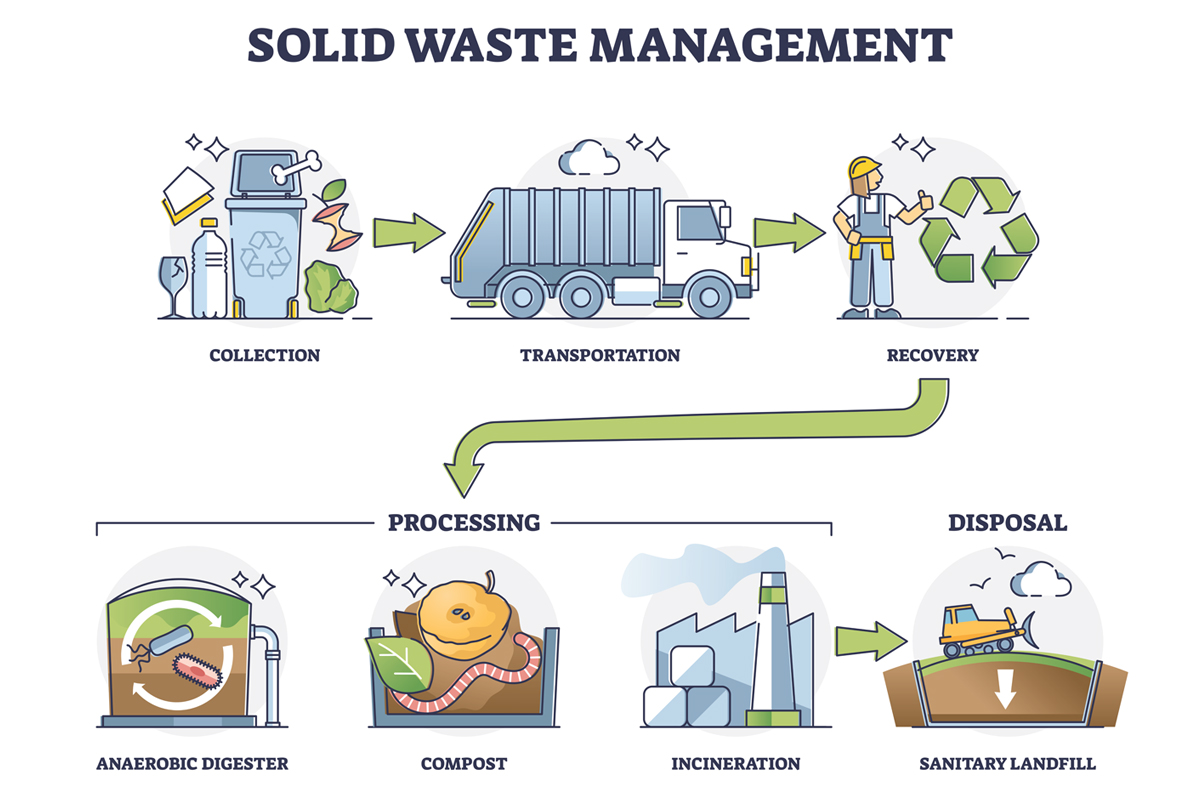
To achieve sustainability, the volume, harmfulness and concentration of waste products must be minimized. This can be accomplished by:
- Reducing the total volume of waste that is generated by private entities and the public, and arriving at waste management facilities. These waste-generation activities are generally addressed by public works agencies in an advocacy role, i.e., stating a strong agency preference for less waste volume arriving at waste management facilities;
- Processing and disposing of that reduced amount of waste effectively and cost efficiently, so that no harm is done to our community citizens or the environment.
As for all public works operations, solid waste management infrastructure and facilities should also strive to minimize energy and water use in all aspects of their operations.
If the above tasks are done well, we will have done more with less and our communities’ infrastructure may be considered economically and environmentally sustainable, from a solid waste management standpoint. Good, thoughtful infrastructure design, completed with foresight, will then make that infrastructure and its operations resilient to extreme weather events and other potential challenges.
Identified areas of overlap covered in the Online Learning Library are waste reduction and the circular economy:
Waste Reduction
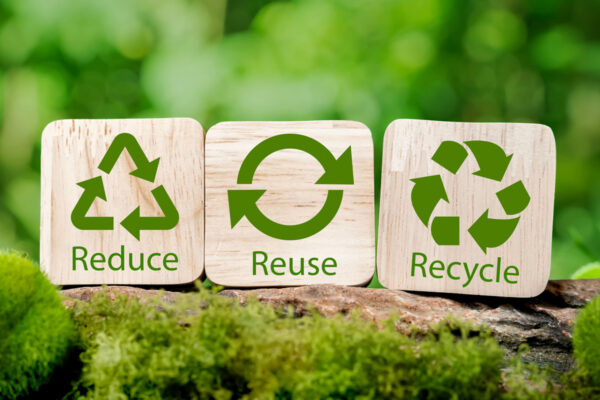 By minimizing waste generation and maximizing the lifespan of materials and resources in the economy, an agency can significantly lower waste processing, disposal, and energy costs, saving taxpayer dollars. The well-known “3 Rs” (Reduce, Reuse, Recycle) strategy and the more detailed “9Rs” strategy (Refuse, Rethink, Reduce, Reuse, Repair, Refurbish, Remanufacture, Repurpose, Recycle and Recover) are of particular importance. Please note that R0 is refuse so there are technically 10 R’s.
Circular Economy (CE)
The circular economy concept is one of the most useful and comprehensive solid waste management strategies, with many effective tools and best practices developed and successfully implemented in recent years.
Circular economy initiatives such as material reuse and water recycling reduce operational costs for public works. By extending the life cycle of products, reducing waste to a minimum, and minimizing energy use in operations and transportation, we significantly reduce our environmental footprint. By creating markets for recycled materials, promoting repair and refurbishment services, and encouraging sustainable procurement, we can also attract and grow businesses in the green economy sector.
Tools and Best Practices
Examples of some of the more prominent solid waste management tools and best practices as well as useful case studies are provided below.
Waste Reduction
Solid Waste Management New Directors Guide Collections and Solid Waste Management New Directors Guide Post Collections
The Solid Waste Management New Director’s Guide, Collections and Post Collections, were created by the APWA Solid Waste Management Committee to provide a foundation for new directors who may not have a firm knowledge base for solid waste collections and post collections.
“Circular design in practice: Towards a co-created circular economy through design”
Provides an excellent overview of the circular design concept, including a good introduction to the “9Rs” strategy.
“An Insight into the Application of Gradations of Circularity in the Food Packaging Industry: A Systematic Literature Review and a Multiple Case Study”
A more specialized case study for the food packing industry, also including a good graphical depiction of the “9Rs” strategy.
“Recycled Materials in Construction”
This video shows how local agencies can increase the use of recycled materials for locally funded projects where state requirements do not apply. Learn the accepted uses for recycled materials that, while potentially in conflict with outdated state standards, are something that can be employed at your community's discretion for locally funded projects.
“Where are they now? Recycling Markets”
Program covers market updates and new trends in the recycling industry. The program lists and describes current recycling market, identifies partnerships to strengthen recycling programs, and describes how to move recycling programs forward to higher recovery rates.
Circularity Centers–The Future of Waste Management for Zero Waste Cities
Circularity centers take a whole systems approach to direct discarded materials to their highest and best use, moving away from a “take-make-waste” linear path toward a zero-waste closed loop. They aim to conserve resources and divert materials from incineration or landfills by means of responsible production, consumption, reuse, and recovery of all byproducts and packaging. This video presents a case study of the Los Reales circularity center in Arizona.
Circular Economy (CE)
“What Can We Learn from Denmark? Hear from the 2021 APWA Jennings Randolph International Fellow about her Study Tour on Waste to Resource Technology & Circular Economy in Denmark”
Denmark is one of the greenest countries in the world and a front runner in the Organization on Economic Cooperation and Development (OECD) in reducing the amount of land-filled waste and viewing waste as an important resource. At the same time, Denmark is also one of the most wasteful societies in the world.
Recycling of Electronic Equipment and Recovery of Precious Metals from E-Waste
This presentation examines the process, critical issues, methods, and innovative practices for recovering and recycling precious metals from electronic waste in computers, cell phones, monitors and screens. It compares effective methods used in both North America and Europe.
20 North American Climate Action Plans Reveal Hundreds of Waste Opportunities
Summary article on embedding waste management strategies into regional decarbonization plans.
Public Assistance Funding: Low-Carbon Materials
Example of funding available when low-carbon materials are used in disaster relief efforts.
Monitoring Progress towards a Resource-Efficient and Circular Economy
This report presents global projections of materials use and their environmental consequences, providing a quantitative outlook to 2060 at the global, sectoral, and regional levels for 61 different materials (biomass resources, fossil fuels, metals, and non-metallic minerals).
London’s circular economy route map
This is a good, complete, state of the art document from a large city.
How Asset Management Can Enable the Circular Economy
This document offers good information on how CE plays heavily into our asset management. It’s relevant to both asset management and circular economy.
Ellen MacArthur on the basics of the circular economy
This video offers a good introduction on the circular economy.
Circular economy and bioeconomy
This is a good, complete, state of the art document from Aotearoa/New Zealand.
A circular economy for Auckland - scoping the potential economic benefits
This is a good private business report from Aotearoa/New Zealand that describes types of private business practices that public works agencies might support and advocate for to reduce their incoming waste loads.
Kalundborg symbiosis
This example offers the most advanced and complete industrial circular economy concept to date. It is an excellent example to aim for.
The Circular Built Environment in Canada: A Review of the Current State, Gaps and Opportunities
This document provides a good summary of state of CE and suggestions for moving forward from an advanced municipal practitioner of CE.
The City of Toronto’s Circular Procurement Framework
This is a good graphic of a well-organized circular procurement strategy for a large city.
Baselining for a Circular Toronto
This is an excellent introductory document that includes good waste stream management graphics.


 Drinking Water
 Green Infrastructure Operation and Maintenance wiki