
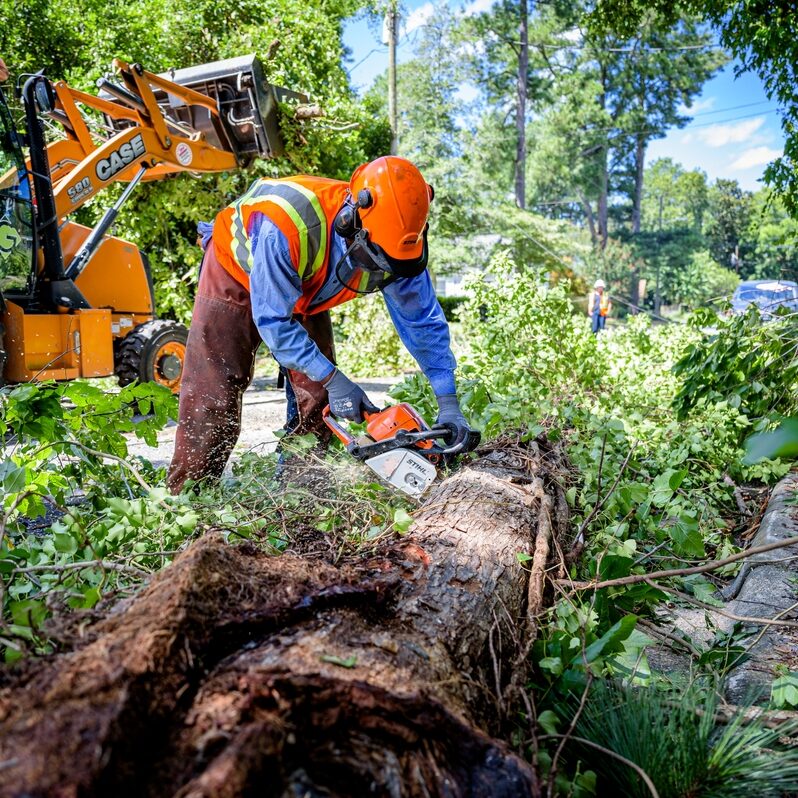
When disaster hits a community, public works is uniquely positioned to fast-track its return to normalcy. Public workers know which roads flood first, the domino effects of debris that clogs ditches, and how infrastructure failures will ultimately impact safety. Through careful documentation, they thread the needle in telling the story of what the community has been through, which can usher in state and federal assistance and faster overall relief.
Tyler Hill serves as infrastructure projects manager for Boone County Public Works in Kentucky, and he’s logistics section chief for the Kentucky Incident Management team. He’s also vice chair of APWA’s Emergency Management Committee. As he outlined in his June 2026 APWA Reporter article (linked below), and throughout this week’s edition of Public Works Radio, effective disaster recovery and debris cleanup hinge on key factors, such as relationships that must be in place well in advance of the days they are needed most.
Another critical theme coming out of this conversation with Tyler is just how vital public workers are as first responders when it comes to disaster relief, strategic cleanup, and bringing back some calm to a community after the chaos of a life-altering event.
Public Works Radio is hosted by Bailey Dickman, Senior Digital Marketing Specialist with APWA. Each episode dives into a wide range of topics designed to educate and inspire, making public works more visible to everyone, from the general public and elected officials to industry peers and the media. If you haven’t already, please subscribe wherever you get your podcasts, rate and review the show, forward it to a friend, and drop us a note at podcast@apwa.org so we can hear your feedback directly!
More Show Notes and Resources
- Public Works Radio Episode No. 4 “The Movement to Recognize Public Works Professionals as First Responders”
- APWA Reporter Article, “Damage Assessments in Public Works: Where Recovery Begins
- APWA Emergency Management Committee
- APWA’s Focus on Emergency Management resources
- Tyler may be reached via email at Thill@boonecountyky.org
- Boone County (KY) Public Works
Transcript
View transcript >
0:00:00.5 Tyler Hill: Mama always told me that an ounce of prevention is worth a pound of cure. Everybody’s got their place and their role. And we know how to handle this, no matter what the disaster is. It’s going to be chaos, you need to do what you can to control it. And having those plans in place, and having everybody know their roles in that plan, can make that first three days feel a lot less painful.
0:00:25.9 Bailey Dickman: When disaster hits a community, Public Works is uniquely positioned to best fast track everybody’s way back to normalcy. Public workers know which roads flood first, the domino effect of debris that clogs ditches and drain pipes, and how infrastructure failures will ultimately impact communities. Through careful documentation, and a little bit of elbow grease, they tell the story of what a community has been through, ushering in state and federal assistance, and faster overall relief. Tyler Hill, serves as Infrastructure Projects Manager for Boone County Public Works in Kentucky, and he’s a logistics section chief for the Kentucky Incident Management Team. He’s also vice chair of APWA’s Emergency Management Committee. As he outlined in his June 2026 Reporter article, and throughout this podcast episode, effective disaster recovery and debris cleanup, hinges on important factors like relationships that must be in place well before they’re actually needed.
0:01:13.4 Tyler Hill: At no point during a disaster, do you want to be three or four days in and go, “Hey, we need to find somebody that can take all of these refrigerators that we’ve got on hand,” or, “all of the 17 truckloads of miscellaneous vegetation.” You want to be able to say that you’ve got… At least, got these relationships. If you don’t have the contract, at least have the relationships in place so that you know who these people are.
0:01:41.5 Bailey Dickman: Another critical theme coming out of this conversation with Tyler, was just how vital the role of Public Works as first responders is, when we’re talking about disaster relief, cleanup, and bringing back some calm to a community after chaos.
0:01:52.1 Tyler Hill: I have yet to meet a firefighter, or a police officer, that would not gladly agree that we are first responders. We are first responders in a much different way, but we are absolutely first responders. That’s the biggest misconception, is that Public Works professionals, haven’t fully embraced what other first responders are saying. They know and agree that we are. We are the guys that can run logistics. We are the women that can operate machines. We are the ones that can get stuff done.
0:02:28.7 Bailey Dickman: Welcome back to Public Works Radio, the official voice of the American Public Works Association. This week, we’re highlighting lessons learned from disaster relief planning. And we have Tyler Hill, representing APWA’s Emergency Management Committee, to give us a 30-minute masterclass. Let’s just jump in.
0:02:45.1 Bailey Dickman: My first question for Tyler, was just about getting all of his titles right. And as you’ll quickly learn, this man has been in the thick of it, and has stories that we can all learn from.
0:02:53.9 Tyler Hill: So my day job is that I am the Infrastructure Project Manager for Boone County Public Works, which is in Northern Kentucky. My alter ego, if you will, is that I am the logistics section chief for the Kentucky Incident Management Team. So the guys that show up when things go terribly, terribly awry. And it’s made up of first responders from all different disciplines.
0:03:17.2 Bailey Dickman: A very underappreciated side of disaster recovery, is just figuring out who can get where and when.
0:03:25.8 Tyler Hill: Well, and so that’s one of the… I don’t want to say… I hate to say funny parts of it all… But at the end of the day, that’s one of the things that Public Works is great at, that not a lot of us realize how good we are at it, until we start talking to police and fire when they’re trying to muddle through those kinds of things. Public Works is really good at finding what you need, figuring out how to get it where it needs to go, and then finding a home for it once you finally get it. At least, that’s where I’ve found my niche in this whole thing, is that Public Works is… We carry the skills for that, and we do it every single day. And police and fire don’t. They don’t think about that kind of stuff, because they’re not ordering metric tons of salt, and aggregate, etc., on a daily basis. Whereas, we are. We’re ordering that stuff, finding places to house it. And so, even when we go to other places, we’re really good at bringing those skills to the table. And so, logistics makes sense.
0:04:26.3 Bailey Dickman: How do you explain what debris management is, to people outside of Public Works?
0:04:32.5 Tyler Hill: The biggest part of almost any incident, is the debris management portion of it. Because whether that debris is natural stuff, or unnatural stuff, like it’s construction material, etc., there’s always that cleanup at the end. And we always have to find ways to find a new home for all of that. I’m sure that in the books that are in the shelf over here, there are official definitions for what debris management is. But ultimately, the definition of debris management is getting the stuff that was destroyed, whether that be trees, whether that be homes, whether that be businesses, getting those cleaned up and getting them handled appropriately, moving forward. And so, again, it’s not always vegetation and wood. Sometimes it’s metal, and concrete, and hazardous waste, even. That’s one of the big things that always has to get figured out at some point in this whole process, is where is that stuff going to go? Because you end up handling it a number of times, because you have to pick it up from all of your residents, and then you have to put it somewhere before it can get sorted and sent off to the place that it ends up being its final destination. Debris management, is the process of collecting all those things, finding a home for it, and then making sure it ends up in the right place.
0:05:53.5 Bailey Dickman: In your debris management process, do you have a hierarchy of, “We pick these things up first, and these things up last?”
0:06:00.8 Tyler Hill: Kind of depends on the relationships that you build. And something that you and I have talked offline about, is getting those relationships in place beforehand. As you build those relationships, you can figure out what needs to go first, what needs to go second. Arguably, hazardous material, depending on if it’s more the household hazardous waste, or if it’s actual hazardous material, those obviously need to go first. Outside of that, it’s really just creating a process and sticking to it. And that, again, that’s another thing that Public Works is really good at. We’re really good at building a process, and doing it the same way, over and over again. And so, getting out there, and communicating to your community, like, “Hey, we’re picking up X.” And so you pick up all of the X, and then you get that to that first resting spot, and then get it off to its final destination. So it’s less about, like, “This has to be done first,” and it’s more about getting a process that works for you, and works for your community partners.
0:07:02.0 Bailey Dickman: Let’s talk about this, kind of, process of relationship building; getting a structure for debris management planned out before something bad happens, on, what I think you called, “blue sky days.”
0:07:13.1 Tyler Hill: Yeah.
0:07:13.8 Bailey Dickman: What does that process look like?
0:07:15.8 Tyler Hill: Anybody who’s listening to this, or anybody that read the article that I wrote, takes anything away, the most important thing is you’ve gotta start on this stuff before the bad stuff happens. Because when you get into that initial emergency push phase, that’s like the first, call it, 24 to 72 hours. So that first day, two, three, it’s chaos. It really is. And so, that’s… From an emergency management perspective, that’s what we are doing, is we wanted to have a plan in place so that we can stick to it, and we can control that chaos. And so, you want to find out who your community partners are. Who are those people that handle scrap metals? Who are those people that will pick up roadside vegetation, so that you can have some of those contracts in place and build those relationships.
0:08:07.0 Tyler Hill: Because at no point during a disaster, do you want to be three or four days in, and go, “Hey, we need to find somebody that can take all of these refrigerators that we’ve got on hand,” or, “all of the 17 truckloads of miscellaneous vegetation.” You want to be able to say that you’ve got… At least, got these relationships. If you don’t have the contract, at least have the relationships in place so that you know who these people are. Because a great example right here in Northern Kentucky, is that we have a partner that will handle all of the scrap metal, whether that be refrigerators, etc. They’ll handle all of that. But they won’t pick up an ounce of it. So we know, going into it, that we have this existing relationship that we can take them whatever needs to be disposed of, but they will not pick any of it up. Whereas, we have a lot of local lawn care services, that will absolutely be chomping at the bit to get in and get into some of the vegetation, because what they do is they ultimately turn that into mulch, and things like that.
0:09:18.3 Bailey Dickman: How often do you update, or take a look at your debris management plan?
0:09:24.5 Tyler Hill: Whenever we have any kind of significant change in leadership, somebody who has some level of responsibility, or some level of responsibility to communicate. So if we have a change in that level, we go over it then. But we also, at least, go over it annually, even if there’s no change in said leadership. And so, that gives us the opportunity to go through, and make sure… Even the people, like me, that have looked at it a thousand times, we know what our responsibility is in that chain of things that are going to happen. And that goes back to what we were talking about before. We want to make sure all this stuff is in place before the bad stuff happens. Because nobody wants to pick a book up off the shelf that’s covered in dust, and it’s like, “Hey guys, here’s our game plan,” and nobody knows what the game plan is. Nobody’s looked at the playbook in years.
0:10:15.5 Bailey Dickman: How different is that playbook for each kind of disaster or debris? Because I imagine Northern Kentucky, you get a variety of weather.
0:10:25.7 Tyler Hill: We do. So we get hit with everything at this point, from tornadoes, to localized flooding, to high winds, to… I think a number of years ago, we actually got hit with a portion of a hurricane, which was a little bit of all the things that I just said.
0:10:45.0 Bailey Dickman: Yeah.
0:10:45.6 Tyler Hill: And so, we get hit with all of it. Different parts of Kentucky get hit with wildfires. And in terms of debris management, the debris management section of those incident playbooks, isn’t incredibly different. It’s really having that debris management plan that you can apply to various situations. But that’s also going into it knowing that in a flooding incident, it’s going to be a lot of mud, it’s going to be a lot of vegetation, it’s likely going to be less debris. Whereas if you get hit with a tornado, that’s going to be more of the construction types of debris.
0:11:21.6 Bailey Dickman: How do public works departments… Like, how do you communicate with residents during debris collection? Schedules, or about separation requirements, or safety precautions. How do you enact that communication plan, when something bad happens?
0:11:36.3 Tyler Hill: Yeah. So a vital part of any incident command team, is a public information officer. So whether that’s your incident commander, or it’s a designated person who is just in charge of exactly what it sounds like, communicating public information. It’s getting that, and making sure that they know their role in the debris management, and that as a public works team, or debris management team, you’re communicating those things about anticipated, like, “Hey, it’s going to take us X amount of time to pick up vegetation. So after that, we’ll focus on scrap metals.” And so, it’s communicating with your PIO, your Public Information Officer, to make sure that they are communicating to the public.
0:12:23.4 Tyler Hill: What’s funny is, at least in Boone County… So Boone County, believe it or not, is the third largest county in the state of Kentucky. But we still very much have a small-town feel. And so, the county has a public information officer, and the sheriff’s department has a public information officer. And the sheriff’s department public information officer, is actually a gentleman that I grew up with. So he has taught me how to speak public information officer, to public information officers. Because, again, coming from a public works background, I don’t always say the right things. But now, he’s taught me how to talk to a public information officer. So now I know how to say the right things to them, so that they say the right things to the public.
0:13:11.1 Bailey Dickman: We talked a little bit about this. But I wanna expand and touch on something we’ve talked about on this podcast before, which is those mutual aid agreements, or regional partnerships, especially when it comes to supporting a local county during a cleanup operation. Can you talk a little bit about the purpose of them? What are their roles?
0:13:30.6 Tyler Hill: A disaster, by definition, is anything that has overwhelmed your organization. So as soon as you need to ask for help, that’s when it becomes, by definition… Maybe not by declaration, but by definition, it becomes a disaster at that point. And so, mutual aid agreements can be really important. A big thing about mutual aid agreements, and something that I’ve witnessed firsthand, is that sometimes with those, you may need to reach a little further out of your comfort zone than you may be used to. Everybody’s used to reaching out to their neighbors. And so, if you have localized flooding, you could probably reach out to your neighbors for that because they may not be experiencing the same thing. Whereas, a couple years ago, we had the Mayfield tornadoes that tore through central Kentucky, tore through Bowling Green. And that devastated multiple cities, multiple counties. And people that were depending on their neighbors for mutual aid, were also depending on their neighbors for mutual aid. And so you may need to reach a little further outside of your bubble to really try to create some of those relationships, in order to truly have a mutual aid agreement that you’re ready to execute, in terms of a big-scale disaster.
0:14:58.3 Bailey Dickman: How do you balance the need to make, sometimes, critical infrastructure repairs; and sometimes, opening roads after a storm? How do you balance what you do in the immediate aftermath of something?
0:15:13.3 Tyler Hill: So it’s a great question. And I will give you my favorite legal answer, which is: it depends. Our number one responsibility, as public works professionals, is to open, maintain, and keep safe, transportation routes. Number one responsibility, to get those routes open. And I say that to say, I know that public works is defined in different ways in different places… So we don’t do water. And I understand that water, electric, etc, is a massive need. So we don’t think about those, because another branch, another group takes care of those things. So for us, it’s about transportation, it’s about critical infrastructure.
0:16:01.4 Tyler Hill: The other part that I will say with that, is that recovery… So everybody tries to think about a disaster, in terms of before the disaster, so mitigation, preparation. Then there’s the disaster, and then there’s response and recovery. The reality of that is, that recovery starts the second that the disaster happens. And so, you have to triage some of those things. Our number one priority is to get arterial routes open, so that the other first responders that are involved in the incident can get through. So when there’s fires, or when there’s people that need to be rescued, or something that the police need to get involved with, that they can get to where they need to get. So a portion of your team needs to be opening those arterials. In terms of recovery, you need to be inspecting those critical pieces of infrastructure to see if they need repair, to see if they need to be looked at.
0:17:04.3 Tyler Hill: But the biggest thing, is getting routes open. Even if they’re not the perfect routes, you need to make sure that you’re getting routes open, so that those other first responders can do their portion of the game.
0:17:16.1 Bailey Dickman: As far as incident management goes, do you talk with police and fire, about what their preferred routes are? Or is it more on the fly, like, “We’re trying to avoid flooding on Oak Street, so we had to open up Elm instead.” What’s the process there?
0:17:32.5 Tyler Hill: So the short answer is, it’s a little bit of column A, a little bit of column B. So arterial routes are, relatively speaking, vital; or relatively speaking, a given. So the major route that runs right through Boone County, is Kentucky 18… Or runs right through Burlington, which is the city that we’re in right now, is Kentucky 18. That has to be open. No one’s going to debate that, regardless. And then as we start working our way off of those arterials… I don’t want to say that we leave it up to police and fire, because we work at it systematically. We don’t just jump all over the place. But we do have to have a certain portion of our focus put on that systematic approach, but then we have to be flexible enough to know that, “Hey, we need to get back on Emerald Drive. Well, we have to clear this road, and clear that road, and clear this street, so that they can get back to Emerald Drive.” And so, we need to have some flexibility to be able to do those kinds of things.
0:18:42.6 Bailey Dickman: And is that, like… Does that take the form of a tree clearing crew that goes with a fire or police cruiser as they’re going around? Or what does that look like on the ground?
0:18:55.6 Tyler Hill: It can look like a lot of different things. But as a rule of thumb, it looks like… We have some heavy operation, and then some light operation. And so, that heavy operation is usually taking care of more of the systematic approach. Whereas that light operation, is usually just a couple of people with chainsaws, chaps, their PPE. They are doing more pushing stuff off the road, and less actually taking care of debris. And so, they’re just getting it out of the way so that they can get through.
0:19:27.3 Bailey Dickman: What’s the biggest misconception that public works departments have about debris disaster cleanup?
0:19:34.6 Tyler Hill: I’ll take a step back from that question, and tell you that the biggest mistake that public works professionals, and people all around the United States make, is that we’re not first responders. And I will tell you that I have yet to meet a firefighter, or a police officer, that would not gladly agree that we are first responders. We are first responders in a much different way, but we are absolutely first responders. Because just let… And maybe, it’s the older ones that are more willing to jump on the fact that we’re first responders, than the younger guys. Because at the end of the day, the ones that have been around for a while, know that in a snow event, we’re the guys that they call so that they can get where they need to go. In the event of flooding, we’re the guys that they call to shut a road down, or we’re the guys that they call to get a tree out of the road. They’ve got our numbers on speed dial.
0:20:39.7 Tyler Hill: And so, that’s the biggest misconception, is that public works professionals haven’t fully embraced, what other first responders are saying. They know and agree that we are. And so, I think that other public works professionals need to get on board with that.
0:21:03.7 Tyler Hill: Beyond that, misconceptions, specifically, about our role in this whole system, is that we play an incredibly vital role in it. We are the guys that can run logistics. We are the women that can operate machines. We are the ones that can get stuff done that is beyond the capability of some of these other organizations.
0:21:28.2 Bailey Dickman: How would you like the public to better understand what it is that public works does when it comes to the moments after an emergency or disaster?
0:21:37.9 Tyler Hill: The biggest thing that I want the public to know, is that we are out there, and we are absolutely doing our best. And that’s every organization, from top to bottom. Because I completely understand that the tree that’s across your power lines is a huge issue. But with that being said, you’re not the only one in that situation. So we are trying to triage things for the community, to make sure that we’re doing everything that we can to get out there and get everything taken care of. And again, that goes from rain, to snow, to trees down. We are out there in full force, sometimes 24 hours a day, trying to get to the places that we need to get to, to get to you, to get to everybody. And so, that’s one of the things that I always feel like… I always feel like there’s somebody that calls in and says, “Hey, my street hasn’t been touched yet.” I can assure you that that’s not the case. And I can also assure you that we are actively working towards you.
0:22:46.8 Bailey Dickman: Always tough when you’re the resident on the street that, “hasn’t been touched.”
0:22:51.6 Tyler Hill: I know, I know. But it’s one of those things where we’re trying to prioritize for the entire community.
0:22:58.6 Bailey Dickman: Yeah.
0:22:58.8 Tyler Hill: And so, we are absolutely making sure that we are working our way to every single resident, every citizen, every customer, whatever your organization chooses to call people that live in your county, city, state; We are working diligently to get to you, I promise.
0:23:14.3 Bailey Dickman: Is there any of the work that the Emergency Management Committee is doing, that you would like to shout out?
0:23:21.1 Tyler Hill: Absolutely. Anybody who hasn’t taken time to look at some of the assets that APWA provides, we make checklists that organizations can use, that are applicable for giant organizations, they’re applicable for tiny organizations, but they really help you see if you have your ducks in a row if you were to be hit with flooding, or to be hit with… The one that I worked on the most recently, was site security. Is your site ready for an incident? And I guess, that’s another thing that, at no point in this whole thing, have you and I really hit on, because we wanted to talk about debris management. But when we talk about incidents, in general, a lot of them, at this point, can be man-made. They can be active shooter type situations, or they can be cybersecurity type situations. And so, those are some of the assets that we provide. “Here’s a checklist that we’ve put together, and we think covers, A to Z, on what you need to have in place before, and what you should be doing during, and after an incident. And who’s responsible for those, and when’s the last time that you went over all of this,” and all that fun stuff.
0:24:35.9 Bailey Dickman: What’s the question I’m not asking about debris management?
0:24:40.0 Tyler Hill: The biggest thing… And I think that we’ve hit on it a couple of times. But I want to make sure that I absolutely… If people listen to this podcast, if they read the article that I wrote, if they’ve done anything, I want to make sure that they walk away from it knowing they need to get ahead of it. So we talked about it before. You need to build those relationships on blue sky days. If you can’t get contracts in place, at least talk to the people that you’re eventually gonna try to get to help you in these situations. So get in front of it, because Mama always told me that an ounce of prevention is worth a pound of cure. You want to make sure that you’re getting in front of it. You want to make sure that you have some things in place on the front end, and that you have that game plan, so that when you get punched in the mouth, you still have a plan. Everybody’s got their place and their role, and we know how to handle this. And we can move forward controlling the chaos, as best as possible. Because no matter what the disaster is, the first… That emergency push, that 24 to 72 hours, is going to be chaos. And you need to do what you can to control it. And having those plans in place, and having everybody know their roles in that plan, can make that first three days feel a lot less painful.
0:26:04.8 Bailey Dickman: Thank you for listening to Public Works Radio, the official voice of the American Public Works Association. And thank you to our sole guest and star of the show, Tyler Hill. Be sure to check out his Reporter article, linked in the show notes.
0:26:15.0 Bailey Dickman: And hey, if you haven’t already done it, go ahead and subscribe, rate, and review us and forward us along to a friend. Don’t be shy about dropping us a note over at podcast@apwa.org, so we can hear your feedback directly. We’ll catch you next time.
Related Resources

Proficiency Levels
Introductory
Focuses on a general or broad overview of the topic, awareness of basic factual recall. Limited experience of the subject matter is necessary to understand content areas.
Applied
Focuses on practical implementation of technical steps or strategies, some prior knowledge and experience of the topic is necessary.
Advanced
Mastery of basic concepts associated with an area has been obtained. Focuses on understanding nuances, advanced concepts, and intricacies with implementation within knowledge area. Strong understanding of how the concept impacts other factors or areas of operations.
Program Types
CLL
Click, Listen & Learn (CLL) are interactive educational webinars. Each program is led by top experts in the field who share new ideas, methods, and technologies in a fast-paced two-hour time frame. These programs are available free to APWA members. CLL programs are eligible for continuing education units (CEUs).
Primer
Primers are used to educate policymakers about public works roles and responsibilities in public rights of way, the impact of federal workforce development policies on the industry and workforce, and the importance of resilient infrastructure.
Public Works Radio Podcast
Public Works Radio is the official podcast of the American Public Works Association (APWA), bringing the stories behind our communities to life. This podcast shines a spotlight on the people and projects that keep our cities running—humanizing the work and the professionals who make it happen. Each episode dives into a wide range of topics designed to educate and inspire, making public works more visible to everyone.
PWX
PWX session recordings cover a wide variety of topics, including integrating modes of transportation, traffic and transit, construction management, emergency management, engineering and technology, fleet and facilities, management, parks and grounds, snow and ice control, and stormwater/flood control, as well as solid waste, roads and bridges and water/wastewater. PWX sessions are eligible for continuing education units (CEUs).
Reporter Articles
APWA Reporter articles are written by public works practitioners on subjects such as solid waste management, water resources, municipal engineering, transportation, equipment services, buildings and grounds, snow removal, and other public works-related topics.
Snow
The Snow Conference session recordings feature public works professionals sharing the latest best practices in managing winter/snow operations more successfully, taking advantage of emerging technologies, understanding and preparing for the challenges ahead, and providing better service to their communities. Snow sessions are eligible for continuing education units (CEUs).
Tech Boxes
A tech box is a PDF take-away that provides information in lists, steps, or defined areas specifically focused on trending technologies.
Virtual Program
Virtual programs are live, interactive educational programs led by top experts in the field who provide timely information or address trending topics within an area. Programs often conclude with an open forum for Q&A.