
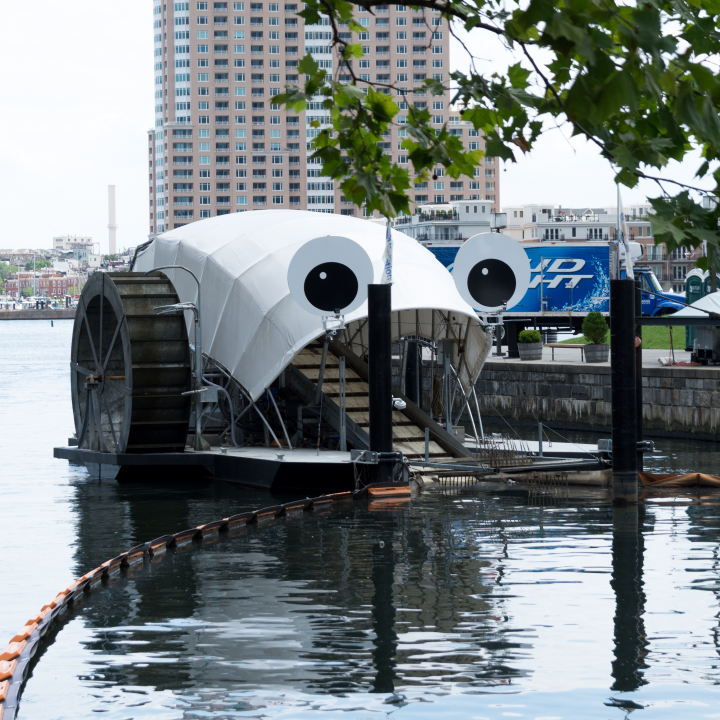
Is there a trash receptacle in your town that has its own fan fest? Probably not. What about googly eyes? Yeah, that’s a new one for us, too. We’re excited to be profiling such a unique trash collection innovation on this week’s Public Works Radio.
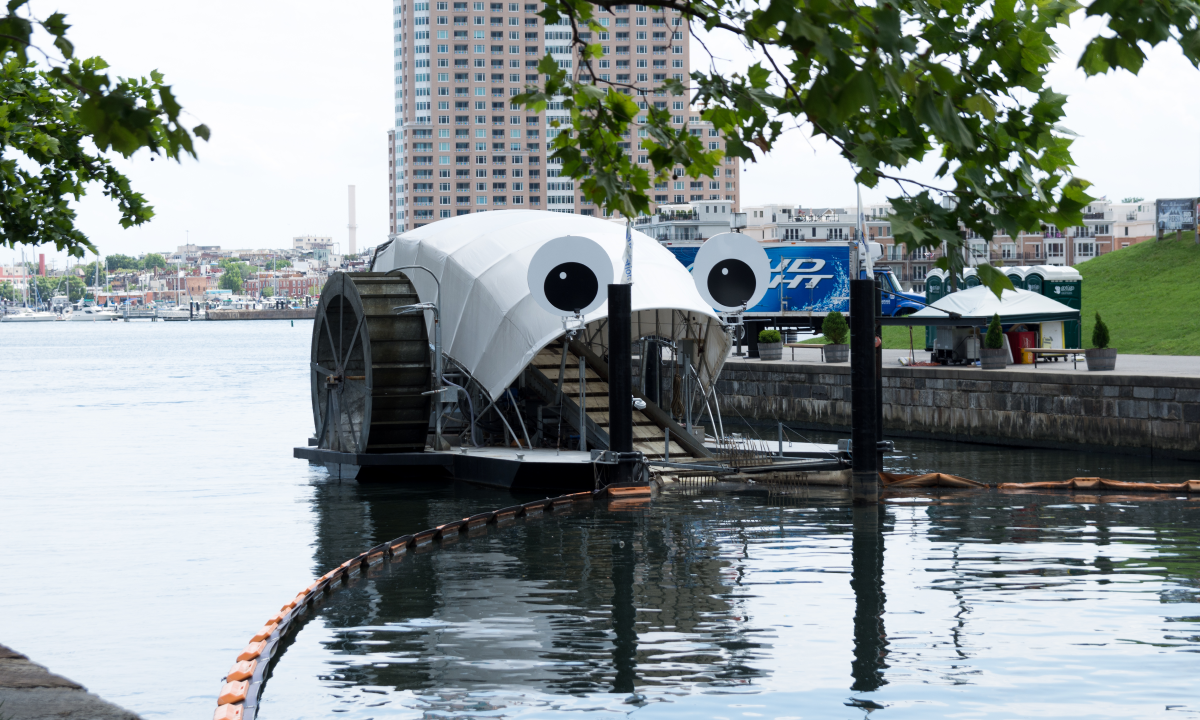
It’s called Mr. Trash Wheel, and it’s a trash collecting waterwheel in Baltimore with trademark googly eyes, and it’s now 12 years old. The infrastructure has grown to four different trash wheels throughout the area and it’s nothing short of innovative, with the capability of gobbling up 500 tons of litter and debris each year.
It’s also gone viral several times, like the time it caught a python. The idea began when Waterfront Partnership of Baltimore, a local nonprofit in Maryland, wanted to improve the health and water quality of Baltimore’s harbor.
Joining us this week is Adam Lindquist, the Vice President of the Waterfront Partnership, and Chelsea Anspach, who serves as the Senior Manager of Outreach and Engagement with the nonprofit, to discuss this technology that was the brainchild of inventor John Kellett.
It has become a cultural icon in Baltimore and beyond, and according to Adam, none of this could have been pulled off without their close working relationship with the Baltimore City Department of Public Works. Even the nearby Public Works Experience museum in Baltimore has been instrumental with support.
And as Chelsea puts it best, “the subject of trash can be depressing, but Mr. Trash Wheel makes it really hopeful.”
The end result is the perfect mix of entertainment, community service, social engagement, and data collection that’s actually been used to shape legislation and inspire art projects. And other communities around the globe have taken notice, with similar initiatives being replicated around the world.
Public Works Radio is hosted by Bailey Dickman, Senior Digital Marketing Specialist with APWA. Each episode dives into a wide range of topics designed to educate and inspire, making public works more visible to everyone, from the general public and elected officials to industry peers and the media. If you haven’t already, please subscribe wherever you get your podcasts, rate and review the show, forward it to a friend, and drop us a note at podcast@apwa.org so we can hear your feedback directly!
More Show Notes and Resources
- Mr. Trash Wheel website
- Mr. Trash Wheel on Instagram
- About the Waterfront Partnership of Baltimore
- Viral YouTube video of Mr. Trash Wheel in a rain storm
- Public Works Experience museum
- Baltimore City Department of Public Works
- Benioff Ocean Science Laboratory
Transcript
View transcript >
0:00:00.2 Bailey Dickman: Is there a trash receptacle in your town that has its own fan club? Maybe a festival, artists, anything like that? I’m gonna guess not. But the one that we’re profiling here on Public Works Radio this week, does. I think part of it is because it has great googly eyes, even if they do sometimes fall off.
0:00:20.4 Adam Lindquist: Welding the springs onto the eyeballs, is a learning process.
0:00:28.7 Bailey Dickman: It’s called Mr. Trash Wheel, and it’s a trash-collecting water wheel in Baltimore with, yes, those trademark googly eyes. And it’s over a decade old. The system is nothing short of innovative, and it has the capacity to gobble up 500 tons of litter and debris each year. It’s also gone viral several times, like the time it caught a live python.
0:00:48.1 Chelsea Anspach: We collected a python snake. Actually two, now, I think. But a bigger one many years ago.
0:00:55.9 Bailey Dickman: It all began when Waterfront Partnership, a local nonprofit in Maryland, wanted to improve the health and water quality of Baltimore’s harbor.
0:01:03.4 Adam Lindquist: We needed to find new ideas, new inventions, new innovations, that were going to help us move the needle on the health and water quality of the Baltimore harbor. He imagined that the farm equipment he worked on as a young boy, up in Pennsylvania, could be modified to… Instead of baling hay in a field, instead of doing that, collecting trash as it came down a river in Baltimore, and picking it up and putting it into a dumpster.
0:01:33.7 Bailey Dickman: That was Adam Lindquist. He’s the vice president of the Waterfront Partnership, and has been with the organization for 15 years. Mr. Trash Wheel, as we’ll learn with this incredibly fun discussion, was the invention of John Kellett, and it’s grown to become four different wheels now, throughout the area. It’s a cultural icon in Baltimore and beyond, with a huge social media following, merchandise, craft beer, and a whole community of fans built around it. Here’s Chelsea Anspach, the senior manager of outreach and engagement with the Waterfront Partnership, with more.
0:02:02.9 Chelsea Anspach: All these people, over 100 people in the community, at home, picked up trash, made a square of this mosaic, and put it together, and it was a Mr. Trash Wheel made out of trash, Baltimore City trash. So it’s just stuff like that, that I think is just so cool, and gets you passionate about the subject of trash, which can be really depressing. But Mr. Trash Wheel makes it really hopeful.
0:02:24.7 Bailey Dickman: According to Adam, none of this could have been pulled off without their close working relationship with the Baltimore City Department of Public Works. Even the nearby Public Works Experience museum in Baltimore, has been instrumental with support.
0:02:35.0 Adam Lindquist: Our partnership with Baltimore City, is specifically with the Department of Public Works. And the Director of Public Works came out and walked around on Mr. Trash Wheel before the device was even installed, and became a believer.
0:02:48.2 Bailey Dickman: The end result, is a perfect mix of entertainment, community service, and data collection, that’s actually been used to shape legislation.
0:02:55.8 Adam Lindquist: We helped Maryland become the first state to ban polystyrene, Styrofoam takeout containers, the first state in the country. We helped pass that legislation, because we saw so many foam containers at Mr. Trash Wheel.
0:03:08.5 Bailey Dickman: Other communities around the globe have taken notice, with similar initiatives being replicated around the world.
0:03:13.9 Chelsea Anspach: There is a trash wheel, though, in Panama City, Panama, who looks like a trash wheel, eats like a trash wheel, called, Wanda Diaz. But Wanda does not have googly eyes.
0:03:23.9 Bailey Dickman: Welcome back to Public Works Radio, the official voice of the American Public Works Association. I’m your host, Bailey Dickman. And this week, we’re talking trash.
0:03:33.8 Bailey Dickman: What is Mr. Trash Wheel?
0:03:35.4 Adam Lindquist: Sure. I can I can kick us off, because Mr. Trash Wheel is almost as old as I am, I think. Did he did he turn 12 this year, Chelsea?
0:03:43.8 Chelsea Anspach: Yeah. 12 years old.
0:03:44.8 Adam Lindquist: [chuckle] Oh, man. Almost a teenager. So Waterfront Partnership, back in… All the way back in 2010, we’re a nonprofit, and we launched an effort to make the harbor safe for swimming and fishing by the year 2020. So we gave ourselves 10 years, which is a pretty tight turnaround time. And we needed to find new ideas, new inventions, new innovations, that were going to help us move the needle on the health and water quality of the Baltimore harbor. And that is when we met John Kellett and his company, Clearwater Mills. And John had a very unique vision. He imagined that the farm equipment he worked on as a young boy, up in Pennsylvania, could be modified to… Instead of baling hay in a field, instead of doing that, collecting trash, as it came down a river in Baltimore, and picking it up and putting it into a dumpster. So John invented this technology that he just called a water wheel. So Waterfront Partnership reached out to John and said, “Hey, we love your idea. And we would love to become a funder, and see this project come to life.” And that is how we landed on Mr. Trash Wheel.
0:05:04.6 Bailey Dickman: The Baltimore City Department of Public Works, and the Public Works Experience, a local museum, have both been vital to making this possible, and also turning Mr. Trash Wheel into the cultural icon it is today. It’s become a point of pride for public works professionals in Baltimore.
0:05:22.3 Adam Lindquist: Our partnership with Baltimore City, is specifically with the Department of Public Works. And the director of Public Works came out and walked around on Mr. Trash Wheel before the device was even installed, and I think, became a believer once he saw the scale of the device, the engineering behind the device, and then, ultimately, saw it working. We could not do what we do, without the support of the Baltimore City Department of Public Works. We also have a great partnership with the Public Works Experience, which is a museum that is pretty much located a block away from Mr. Trash Wheel, right along the same river. And so, we use that museum for Baltimore City school field trips, when kids want to come down and learn about Mr. Trash Wheel. And we actually host events there. And there is an operational model of Mr. Trash Wheel that lives in this museum, as well.
0:06:17.7 Adam Lindquist: I mean, I don’t think you can do it in… At least, in a city in America, without a strong partnership with your local public works department. And they love it, right? I mean, it’s put them on the map. So when they go… When the Department of Public Works of Baltimore City, goes to conferences around the country, or around the world, everybody who works in the trash field, has heard of Mr. Trash Wheel. And so, I think it’s really given them a cool project that they’re really excited to be associated with.
0:06:46.6 Bailey Dickman: How did you guys make it fun? Because if our listeners haven’t seen Mr. Trash Wheel, it is effectively a large water wheel encased in a shell, with googly eyes, that picks up trash from the Baltimore harbor. How did you guys decide to make it fun?
0:07:03.2 Adam Lindquist: [chuckle] Yeah. And that’s a great question, and a great description, too. Mr. Trash Wheel is big. I think one thing that people underestimate, is how big he is. He is bigger than a garbage truck. It is a big piece of infrastructure, and it doesn’t move around the harbor. It stays in one place. We put it at the end of a river or stream. We actually have four of these in Baltimore, which I’m sure we’ll get to, but they’re all placed at the end of stormwater outfalls, or streams, or rivers, and they capture trash that flows down those waterways.
0:07:33.2 Adam Lindquist: So, how do we make it fun? Well, I actually had Chelsea’s job when I started here. And I was really trying to get the community engaged in cleaning up the Baltimore Harbor. So my question was always, “How do we make this fun? How do we make it interesting?” And we’d done a number of different projects, like floating wetlands, and oyster gardening, that were all designed to engage the community. And when I was presented with this giant trash interceptor that was floating in the river, it was really a unique challenge, because I didn’t know how to get people to engage with it. You can’t touch it, you can’t really have volunteer days around it. Like, what do you do with it? But I did shoot a video of it, and put it up on my YouTube channel, which went viral, and went to number one on Reddit.com. This is all the way back in… What? 2014, I think. And that viral video really inspired our organization to think differently. Like, “How are we gonna build on this?” And there were no googly eyes yet. But that’s when I went down into my basement, and built the first set of Mr. Trash Wheel googly eyes, which were four feet tall at the time. And we went out there, and put them up on Mr. Trash Wheel, and everyone just kind of fell in love. Also needed to name it, and so that’s when worked with a team of great creative individuals at a company called, What Works, and we came up with the name, Mr. Trash Wheel. And we thought, people are gonna love this.
0:08:59.3 Chelsea Anspach: Actually, one of my favorite Adam quotes, is he said… What did you say? “I’m just the guy who put the googly eyes on the thing.” And I think that’s so funny, because that made Mr. Trash Wheel.
0:09:09.4 Adam Lindquist: Yeah. Sure, sure. I mean, that’s funny. That’s a behind-the-scenes thing, is that there was an architecture firm hired to design this device. And, yeah. I often say I’m the jerk who came along and said, “You know what would really make this look nice? Yeah. Let’s put some googly eyes on this thing.” And I can’t say that the architecture firm, necessarily, loved the googly eyes at first, though I think they’ve come to be… I think they’re believers now.
0:09:32.3 Chelsea Anspach: They’re an engineering marvel, because those eyes can withstand wind. So they can kind of move back and forth.
0:09:38.0 Bailey Dickman: I was gonna ask about that. So they’re like… It’s so hard to describe it without a visual. But they are, effectively, like… It’s almost like a snail shell that the eyes are put off to the side of it, and they’re flapping in the wind as it moves. How many times does Mr. Trash Wheel lose an eye?
0:09:58.2 Chelsea Anspach: Oh, maybe, twice…
0:09:58.9 Bailey Dickman: Does he ever lose them?
0:09:59.9 Adam Lindquist: Yeah, yeah. No. Look, it’s happened. It’s been a learning experience. Because, yeah, you’ve gotta be able to withstand, like Chelsea said, all of the elements. So we’ve had a couple instances, and we have like a live webcam on Mr. Trash Wheel, so we’d come down in the morning and the eye would be gone. And so we’d go rewind the webcam, and be like, “Oh, yeah. It fell right off.” And so, welding the springs onto the eyeballs, is a learning process. So, yeah. We have… And then we’ve actually had people come in from the National Aquarium, with like an underwater camera, and grappling hooks, to help us retrieve lost googly eyes from the bottom of the harbor.
0:10:40.2 Chelsea Anspach: They’re heavy. They’ll sink. Like, they are… That’s metal.
0:10:44.2 Bailey Dickman: What makes the water, or trash situation, in Baltimore so unique?
0:10:49.1 Adam Lindquist: I’ve received phone calls and emails from… I mean, at this point, like every city around the world, inquiring about this technology. I think what made Baltimore unique, is that we are a city, and our city government, we’re very supportive of entrepreneurs. We’re very supportive of people who want to step up and do some good, and make a difference. So we were really able to permit a large-scale trash interceptor in our river. And there are a couple more trash wheels around the world, now. But I think that that’s a big hurdle for other cities, like Boston, or New York, who have reached out to us from time to time. And they just have so much more red tape to get through. But Baltimore is the type of city that really clears the way for people like John with a vision. And I think that’s what makes Baltimore so unique. That, and we’re kind of known for our kitsch.
0:11:47.0 Bailey Dickman: How much trash does Mr. Trash Wheel collect in a year?
0:11:50.9 Adam Lindquist: Well, that’s a great question. It really depends on rainfall. In a drought, Mr. Trash Wheel isn’t operating much at all, because about 90% of our trash is driven by rain. So when trash is moving down the streets, moving down the storm drains, it’s flowing into our streams, and into our harbor. And that’s when we’re doing the work. The four trash wheels in Baltimore, are capable of picking up to about 500 tons of litter and debris, every single year. But again, that’s dependent on rainfall.
0:12:21.7 Bailey Dickman: What’s the weirdest thing that Mr. Trash Wheel has picked up?
0:12:25.7 Chelsea Anspach: We collected a python snake. Actually two, now, I think. But a bigger one many years ago. Was that like 10 years ago, Adam?
0:12:34.3 Adam Lindquist: At least.
0:12:35.0 Chelsea Anspach: Yeah. So not a piece of trash, a living creature. But it made the news that day. It was a slow news day in Baltimore. Everybody was reaching out. People were calling Adam at the office, being like, “That’s my snake.” And I don’t know how you prove that’s your snake. Were people sending you color schemes or something?
0:12:53.4 Adam Lindquist: Oh, yeah. People sent me their snakes, and I had to Google how to do that. But you match the spots. So, yeah. We called it, Mr. Trash Wheel’s lost python. And it was alive. It was wrapped up on the power inverter, which is the warmest spot on Mr. Trash Wheel. And it just became… It was pretty much our first ever viral moment with Mr. Trash Wheel. All of a sudden, the number of followers on social media shot way up. We haven’t even talked about the social media component.
0:13:22.5 Adam Lindquist: It’s one thing to put googly eyes onto a trash interceptor, but we went the extra step of giving it a social media account, and allowing Mr. Trash Wheel to speak for itself. And that’s actually how Chelsea got involved with our organization, originally. She became the voice on social media of Mr. Trash Wheel. Not a literal voice, but she was coming up with all of the crazy things that Mr. Trash Wheel would say, whether he was commenting on weird things that he pulled out of the harbor, or commenting on pop culture, honestly. And it was a really unique component to this project.
0:13:55.4 Chelsea Anspach: But before I even started working at Waterfront Partnership, that’s what pulled me into the trash wheels. I think, my first experience with the trash wheel, was just walking around the Baltimore harbor and stumbling upon one. I thought it was a piece of artwork, some type of sculpture in the water. Like, what is this thing? Then looking it up, finding out it has a function, it’s cleaning up the water. But then finding this super silly Instagram account. And then, just the community around this Instagram account… Like, the comments, and just the events that were going on with the trash wheel, they were just so silly. I loved it so much. I then got involved with something called Fan Fest… Mr. Trash Wheel Fan Fest, where a lot of artists submit arts and crafts, anything you love about the trash wheel. And I was one of those crazy fans who submitted to Fan Fest. And that’s just how I started meeting everybody, and getting involved with that community.
0:14:49.5 Bailey Dickman: So let’s talk about that community outreach part of it. Because trash is boring, and gross. And people don’t like to think about it. How do you guys build that community up, year round? What do you do to get people in Baltimore, really excited about the thing that picks up our trash from the harbor?
0:15:06.3 Adam Lindquist: We make it fun and engaging. And I think also, we demonstrate that there is a solution. So many people became so apathetic about trash in waterways. Like, “How can we ever do anything about this?” And so, it was really powerful to show that a Baltimore inventor was operating a machine here in the harbor, that was making a measurable difference in the amount of trash in our waterways. And then on top of that, adding the googly eyes, and the funny social media, gave people an opportunity to engage with it. And I think people just loved the optimism, combined with the bizarre nature of, “Hey, I pulled this baby doll out of the harbor. Isn’t this gonna give everyone nightmares?” Or Mr. Trash Wheel saying, “This is gonna give me nightmares.” Or he pulls a mattress out of the harbor, and he says he’s gonna open the world’s soggiest Airbnb. Chelsea, I don’t know if you have any of your favorite Trash Wheel humor. Does anything come to mind?
0:16:02.8 Chelsea Anspach: Oh, my gosh. I don’t even know. I was just thinking more about the art, and things people make, and they’re inspired by these pieces of trash that are picked up out of the harbor. People will use the trash. They’ll do their own pickup. We’ve had events where people do their own litter pickup, and create artwork out of it. We did a huge Mr. Trash Wheel mosaic, one year. All these people, over a hundred people in the community, at home, picked up trash, made a square of this mosaic, and put it together. And it was a Mr. Trash Wheel made out of trash, Baltimore City trash. So it’s just stuff like that, that I think is just so cool, and gets you passionate about the subject of trash, which can be really depressing. But Mr. Trash Wheel makes it really hopeful.
0:16:49.5 Adam Lindquist: And I think using social media in a new… What was new at the time… Way. We’re talking about 2014, using… Originally, we were on Twitter. And this idea of giving an inanimate object a voice on social media, was still relatively new. And I think that introduced environmentalism in Baltimore City, and our mission to make the harbor safe for swimming. It introduced us to a much younger audience, than maybe, the traditional environmentalist audience. And I thought that was really powerful.
0:17:23.6 Bailey Dickman: I saw on your website, that you guys do events where you’ll invite the community into count out a dumpster worth of Mr. Trash Wheel trash. How do you go about inviting the community into, really, handpick some of the trash? Why do you do it, and how do you do it?
0:17:39.5 Chelsea Anspach: We were just talking, because we have an event, called, Dumpster Dive, which is exactly what you’re talking about. And we were just saying the other day, “When are we gonna hit the limit of volunteers who want to come sort through a Mr. Trash Wheel dumpster?” And the answer is: we haven’t hit that limit yet, or come close to it. People are so excited to dive into that dumpster, and figure out what’s going on with the trash.
0:18:01.9 Chelsea Anspach: So the Dumpster Dive, is exactly what it sounds like. We get over a 100 volunteers, who come over, they dig in the trash, they sort it out into different categories. And then we count what we see. So water bottles, cigarette butts, wrappers, things like that. We even have a fun party table, where we put toys, or things we think are funny, from the dumpster. And the excitement around that event is just… It surprises me every year, even though I know what to expect. But then I don’t, because there’s so many people. There’s new faces, there’s old faces. They are just so excited to be a part of this mission to clean up the harbor.
0:18:36.1 Bailey Dickman: I noticed that you guys have a ton of data, just freely available to the public.
0:18:40.1 Adam Lindquist: Yep.
0:18:41.0 Bailey Dickman: Why do you feel like giving the public the data, as well, is important?
0:18:45.8 Adam Lindquist: I think that was a really important move that we made in the early days. I definitely am aware of other organizations that have their own cleanup contraptions, who view this data as kind of proprietary, and don’t share it freely. I guess, because we are a nonprofit, and we’re so focused on just cleaning up the Baltimore harbor, that we thought it would be more powerful to make all of our collection data freely available. Because we really wanted to use that data… We wanted the public to see and use that data, to help us pass legislation that would reduce the amount of trash ending up in the Baltimore harbor in the first place. And also, Mr. Trash Wheel has become a global source for people who are doing research, trying to understand the impacts of plastics on our oceans, and other waterways. They come to Mr. Trash Wheel to download our spreadsheets, and use it in their research, because we’ve made it freely available. And I think that’s a really powerful part of the Mr. Trash Wheel story.
0:19:47.9 Bailey Dickman: So there’s four trash wheels in Baltimore, right? Do you want to briefly go over them and their different personalities, and where they are?
0:19:56.2 Chelsea Anspach: I love Gwynnda, the Good Wheel of the West. She is… I mean, she is still… I’m like, she’s been active for a couple years now, but she is our newest. I still consider her the baby of our harbor, our Trash Wheel fleet. But she’s also the biggest trash wheel here in Baltimore. She’s in West Baltimore on the Gwynns Falls. And what makes her unique? Physically, what makes her unique, is she’s big and she also has a claw, unlike the other trash wheels. I know, pretty cool. She gets a lot of natural debris, like huge tree trunks, pretty much trees that come down there. So they need a little extra help getting that kind of debris out of her way so it’s not going up her mouth. But her personality, she’s a little more witchy. She is inspired by Wicked. She was also named by the community. What else? Oh, and she has beautiful purple eyes.
0:20:46.6 Adam Lindquist: Of course, Mr. Trash Wheel’s the original. We have Professor Trash Wheel, over in our Canton neighborhood. And then we have Captain Trash Wheel, who is part of an urban nature refuge, called, Masonville Cove.
0:21:01.5 Bailey Dickman: What would you recommend for, say, a public agency, who’s trying to get their community more interested in picking up trash, or more interested just in trash collection, in general? What would you recommend, some easy actionable steps that they could take, to invite their community in more?
0:21:20.4 Adam Lindquist: I mean, people want to feel good about making a difference in their communities. And I think, that adding a dose of humor to it, showing you have a sense of humor, really opens people up to thinking of you and your organization as more of a collection of people trying to do good in the world. And people want to be part of that story.
0:21:42.5 Chelsea Anspach: The simple answer is, make it fun. But I also think when you do show that there’s a group of people, and they are doing something, and you want to be a part of that group of people. Like, you’re making it inviting, you’re creating just this sense of friendship, in a way, and community. We have so many people who have… I don’t know. They’ve just kind of formed their own little groups here in Baltimore, who maybe started over their trash wheel fandom, and then they’ve taken it a step further and volunteer with a different organization, or volunteer with us in a different capacity. I think if you make it fun, and you create that sense of community, I think you can push the bounds of volunteering and litter pickup with that.
0:22:25.4 Adam Lindquist: I wish it was as simple as just slapping googly eyes on everything [chuckle].
0:22:28.9 Bailey Dickman: I think we should give it a shot. I think we should give googly eyes on trash trucks, a shot. I think we should put them on snowplows. I think it would be fun. I think we should, at least, give it the old college try.
0:22:40.2 Chelsea Anspach: Yes.
0:22:40.9 Adam Lindquist: Yeah. Right? Like, yeah. I mean, look, I support it. I think we should anthropomorphize anything that we can. but it certainly worked for us. And just to underscore the amount of community that is formed around Mr. Trash Wheel, people make trash wheel artwork; kids have Mr. Trash Wheel birthday cakes; people dress up as Mr. Trash Wheel for Halloween. And then, to support our work, we actually sell Mr. Trash Wheel t-shirts, Mr. Trash Wheel stuffed animals. There is, actually, a craft beer that’s available here in the Baltimore area, called, Mr. Trash Wheel’s Lost Python Ale. And that beer has been going on for, I think, 10 years we’ve been selling that beer now.
0:23:19.9 Bailey Dickman: Mr. Trash Wheel’s been running for, now, over a decade. You said that the Waterfront Partnership’s mission was to make Baltimore Harbor safe for swimming, safe for fishing. Did you all succeed?
0:23:30.8 Adam Lindquist: Well, I think that it is a spectrum. I think the idea of a harbor that is swimmable 365 days a year, is still the vision and the goal. But I don’t think you’ll find any urban waterway in the world, that can make that claim. But we have definitely moved the needle, to the point where we are now hosting swimming events in the Baltimore Harbor every single year. It kicked off in 2024. I think COVID slowed us down a little bit, so we didn’t quite hit that 2020 goal. But by 2024, we were hosting public swimming events in Baltimore Harbor, for the first time, in over 40 years. And they were… They’ve been incredibly popular. The events sell out almost immediately. Then, there’s another nonprofit that has recently formed, called, Baltimore Open Water Swimmers, who now host race… Swim races, around the Baltimore Harbor. So I think that we’ve made tremendous progress. There’s still more work to do. But we’re so excited that we’ve entered this new phase of actually hosting swimming events in the Baltimore Harbor.
0:24:36.9 Bailey Dickman: So we’ve had one decade, and some change, of Mr. Trash Wheel. What’s… What’s the next decade of Mr. Trash Wheel look like?
0:24:44.2 Chelsea Anspach: Trash wheels in space! No, I’m just kidding.
[laughter]
0:24:46.8 Bailey Dickman: Hey, there’s trash up there, too.
0:24:49.0 Chelsea Anspach: There’s trash in space. Yeah.
0:24:51.2 Adam Lindquist: I mean, Mr. Trash Wheel would love to go to space. So I would say, that we have increasingly… We’re not looking to build more trash wheels in Baltimore. We’ve got four here at major outfalls. They are providing entertainment, they’re providing a public service, and they’re providing data. And what we are increasingly doing, is using that data to help pass legislation. So we noticed, for example… We helped Maryland become the first state to ban polystyrene, Styrofoam takeout containers. The first state in the country.
0:25:28.1 Adam Lindquist: We helped pass that legislation, because we saw so many foam containers at Mr. Trash Wheel. I mean, they float so well. And so, there’d just be this mat of white garbage every time it rained, and that was really disheartening. So we got involved in this effort to pass this legislation. And after it passed, we saw an 85% reduction in the amount of foam ending up in our waterways. And what an eye-opener to see that. We can do all the community outreach we want, we can talk about behavior change on social media, but nothing prompts behavior change like legislation. And we are trying to do that with plastic bottles, now. Beverage container litter, continues to be one of the number one items that we pull out of the Baltimore Harbor. And there are 10 states in the country that already have beverage container deposit laws, where you pay a small deposit every time you purchase a beverage container, and that you redeem that beverage container when you return it. And that’s been incredibly effective in the 10 states that have those laws, in keeping beverage containers out of our waterways. And so, that’s what we’re working towards in the years ahead.
0:26:45.1 Bailey Dickman: What are the international trash wheels that have been inspired by Baltimore’s? Do you know where they are? Or do they also have googly eyes? This is really important to me.
[laughter]
0:26:58.8 Adam Lindquist: Well, Chelsea and I actually traveled out to Santa Barbara, California. We went to the University of Santa Barbara, where they have the Benioff Ocean Research Institute. And what was really interesting… They flew us out there, because they wanted Mr. Trash Wheel to be a model for a grant program they wanted to create, that would fund organizations in cities around the world who wanted to get litter out of their waterways. And basically, they flew us out there to say, “Mr. Trash Wheel should be your model. Look to what he’s doing.” And that was amazing.
0:27:33.7 Adam Lindquist: And then, we actually went back a couple years later. And they flew in all of the different grant recipients who had implemented different devices, inspired by Mr. Trash Wheel. So Chelsea and I got to be there. And it kind of felt like these were our children, or something, because they just looked up to us like we were this global model. And that’s a perspective you don’t always get when you’re just in Baltimore, just trying to clean up the harbor. So that’s been really cool to see.
0:28:04.1 Chelsea Anspach: It was interesting during that, because I saw different types of trash interception. There is a trash wheel, though, in Panama City, Panama, who looks like a trash wheel, eats like a trash wheel, called Wanda Diaz. But Wanda does not have googly eyes. But Wanda has a lot of personality, and still is collecting a lot of trash in Panama.
0:28:22.1 Adam Lindquist: The other one is in Newport Beach, California.
0:28:24.2 Chelsea Anspach: Yeah. And they’re, actually… I just was on the phone with them… They’re gonna have their own dumpster dive with that trash wheel in the coming month.
0:28:32.5 Bailey Dickman: What am I not asking you about, that you think is really important to your community?
0:28:37.1 Adam Lindquist: People reach out all the time, from other cities around the world, looking for… People mistakenly think that if you buy a trash wheel, and install it in your waterway, that the problem is solved, and you’re done, and you can wipe your hands and walk away. That is not the case. And I think one of the most important things that people don’t realize about this technology, is when you collect the trash from the river, you own that trash. And it is now your responsibility. And to their credit, we have an amazing partnership with the city of Baltimore, who handles the disposal of all the trash that we collect from the harbor. So we’re not paying the tipping fees at the dumps to get rid of this trash.
0:29:18.0 Adam Lindquist: And I think that’s something that’s lost on a lot of people, because operation and maintenance is the real lift. I’ve always said, capital projects… People love to give money to capital projects. But keeping a project running for… Mr. Trash Wheel, what has been 12 years now? I mean, that’s a real challenge, and required this great partnership between our nonprofit, and the city of Baltimore. And we couldn’t have done it without them.
0:29:43.8 Bailey Dickman: Chelsea, do you have a fun Mr. Trash Wheel fact?
0:29:45.9 Chelsea Anspach: I mean, that is a good message for everybody who is out there, who wants a trash wheel. I was gonna say something a lot more simple, because a lot of people don’t know Mr. Trash Wheel is pretty good at cleaning up oil spills. He has these booms that are in front of him, that any water that is coming down the Jones Falls, which is where he sits, will go to Mr. Trash Wheel. So if you have an oil spill in that waterway, we can put some oil pads down, and it will make its way onto Mr. Trash Wheel, before entering the bigger harbor, and then the bay, and then the ocean, and all of that.
0:30:18.1 Bailey Dickman: Thank you for listening to Public Works Radio, the official voice of the American Public Works Association. And thank you to our guests, Adam Lindquist and Chelsea Anspach. And listen. Trust me when I say Mr. Trash Wheel is something that you have to see to believe. So be sure to check out some of the resources and videos linked in the show notes.
0:30:35.1 Bailey Dickman: Of course, if you haven’t already done so, go ahead and subscribe, rate, and review the show, forward it along to a friend. And don’t be shy about dropping us a note over at podcast@apwa.org, so we can hear your feedback directly. We’ll catch you next time.
Proficiency Levels
Introductory
Focuses on a general or broad overview of the topic, awareness of basic factual recall. Limited experience of the subject matter is necessary to understand content areas.
Applied
Focuses on practical implementation of technical steps or strategies, some prior knowledge and experience of the topic is necessary.
Advanced
Mastery of basic concepts associated with an area has been obtained. Focuses on understanding nuances, advanced concepts, and intricacies with implementation within knowledge area. Strong understanding of how the concept impacts other factors or areas of operations.
Program Types
CLL
Click, Listen & Learn (CLL) are interactive educational webinars. Each program is led by top experts in the field who share new ideas, methods, and technologies in a fast-paced two-hour time frame. These programs are available free to APWA members. CLL programs are eligible for continuing education units (CEUs).
Primer
Primers are used to educate policymakers about public works roles and responsibilities in public rights of way, the impact of federal workforce development policies on the industry and workforce, and the importance of resilient infrastructure.
Public Works Radio Podcast
Public Works Radio is the official podcast of the American Public Works Association (APWA), bringing the stories behind our communities to life. This podcast shines a spotlight on the people and projects that keep our cities running—humanizing the work and the professionals who make it happen. Each episode dives into a wide range of topics designed to educate and inspire, making public works more visible to everyone.
PWX
PWX session recordings cover a wide variety of topics, including integrating modes of transportation, traffic and transit, construction management, emergency management, engineering and technology, fleet and facilities, management, parks and grounds, snow and ice control, and stormwater/flood control, as well as solid waste, roads and bridges and water/wastewater. PWX sessions are eligible for continuing education units (CEUs).
Reporter Articles
APWA Reporter articles are written by public works practitioners on subjects such as solid waste management, water resources, municipal engineering, transportation, equipment services, buildings and grounds, snow removal, and other public works-related topics.
Snow
The Snow Conference session recordings feature public works professionals sharing the latest best practices in managing winter/snow operations more successfully, taking advantage of emerging technologies, understanding and preparing for the challenges ahead, and providing better service to their communities. Snow sessions are eligible for continuing education units (CEUs).
Tech Boxes
A tech box is a PDF take-away that provides information in lists, steps, or defined areas specifically focused on trending technologies.
Virtual Program
Virtual programs are live, interactive educational programs led by top experts in the field who provide timely information or address trending topics within an area. Programs often conclude with an open forum for Q&A.