
Committee Connection
Theresa Little Watley, MSEM, PMP
UPROW Committee Chair
 One of the Utilities and Public Rights-of-Way (UPROW) Committee’s goals is to help public works professionals better understand and explain the role of the public right-of-way (ROW). As communities see more utility work, broadband expansion, transportation improvements, and other infrastructure projects, the right-of-way has become an increasingly busy and shared space. Helping others understand what happens there is an important part of public works.
To support those conversations, the UPROW Committee developed the What’s in a Right-of-Way? infographic. It provides a simple, visual overview of the many assets, infrastructure systems, and partners that share the public right-of-way, helping explain why planning, communication, and coordination are essential. The infographic features overviews of key areas of ROW management, along with links to educational resources and further information on each topic. The infographic is designed to be a practical resource that members and chapters can use in many ways. It can kick off a chapter program or discussion, help explain ROW management to elected officials or community groups, introduce new employees to the many responsibilities of public works, or provide context for conversations about utility coordination, permitting, and infrastructure projects. It’s a simple tool that helps tell a complex story.
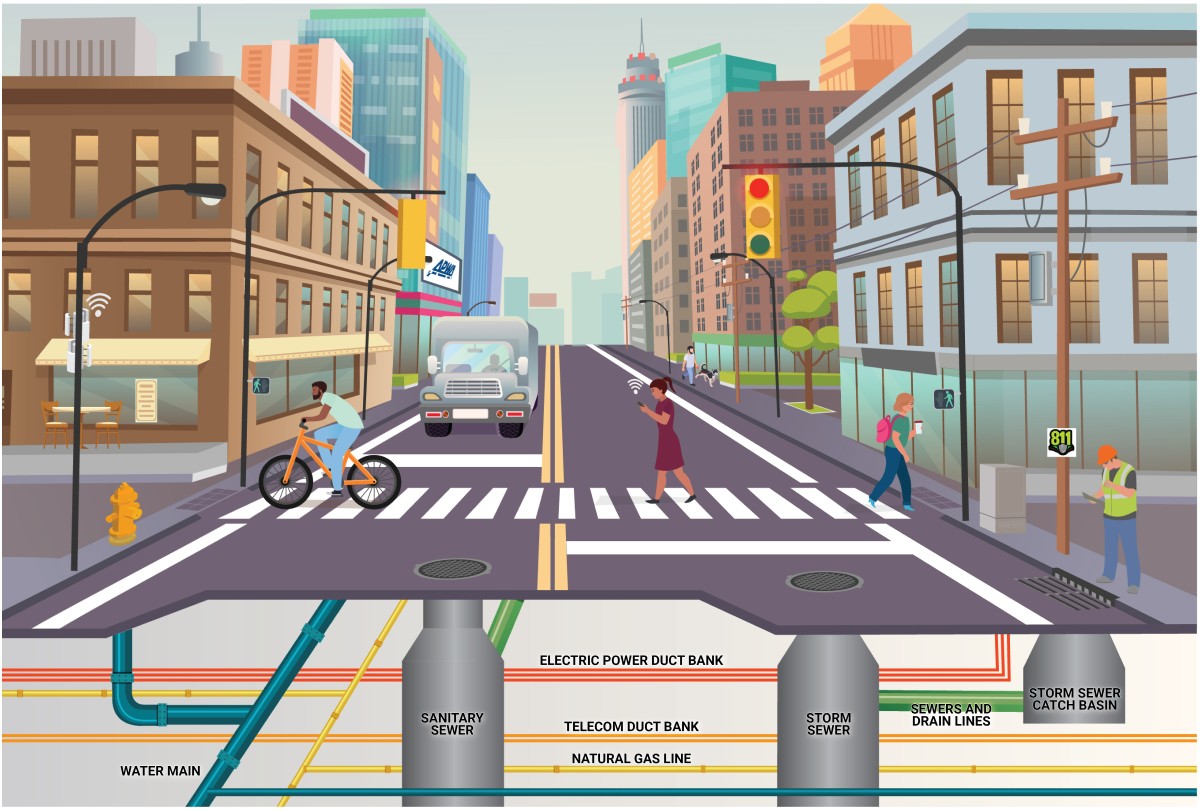
The committee is proud to create resources that help public works professionals educate others and show the value of the work they do every day. We encourage you to explore the infographic, share it with your colleagues, and use it at your next presentation, chapter meeting, or staff training.\
Live Programs
Subsurface Utility Engineering Essentials for Public Works: Smarter Utility Investigations
Subsurface utility engineering (SUE) is an engineering practice that focuses on mapping and documenting existing utility facilities to reduce risks during the project delivery process. This live virtual session will provide an overview of the agreed-upon principles and procedures for conducting utility investigations.
Trending Resources
Data Center Development Toolbox
As data center development becomes an increasingly important issue for communities across North America, the APWA Technology Committee developed this toolbox to help public works professionals understand the fundamentals, identify key considerations, and engage confidently in planning for proposed data center projects.
Public Works Benchmarks: Transportation and Rights-of-Way Management
This document presents a detailed overview of key metrics pertaining to transportation, roadway, and rights-of-way management, providing insights into the operational dynamics and resource utilization within these organizations.
Managing Public Art in the Right-of-Way
This webinar provided an in-depth look at how the City of Indianapolis oversees its public art program, from initial planning to long-term maintenance. Gain insights into key policies, communication strategies, risk mitigation, and case studies that illustrate both the challenges and successes of public art management.
Memorials in the Right-of-Way
Members of different agencies across the country outlined how they address memorials in the right-of-way. This webinar will share how agencies can ensure the safety and well-being of all while also allowing those affected by deaths in the right-of-way to grieve.
RoDARS: Streamlining Road Disruption Management in Urban Environments
Learn how the City of Toronto used RoDARS Central to streamline road work permitting, improve coordination among utilities, contractors, and city staff, and reduce the impacts of construction in one of Canada’s most congested urban environments.
Policymaker Primer: Public Works and ROW Management
Policymaker Primers supplement APWA’s official Public Policy Priorities, providing additional information and context for issues tangential to emergency management, transportation, and water resiliency.
811 Day
 August 11 is 811 day—a timely reminder to always contact 811 before starting any digging project to have underground utilities marked. Whether you’re installing a mailbox or breaking ground on a major construction project, contacting 811 helps prevent accidents, outages, and costly repairs. Our partners at Common Ground Alliance have gathered tools and resources to help communities manage or partake in campaigns promoting 811. View the toolkit here.
Certification
CPII Recognizes Expertise in Utilities and Public Rights-of-Way
 Utilities and right-of-way inspections are two key areas covered on the Certified Public Infrastructure Inspector (CPII) exam. Inspectors working in utilities and public rights-of-way (UPROW) oversee infrastructure systems and construction activities within public easements and rights-of-way to help ensure projects are completed safely, efficiently, and in compliance with applicable standards.
If you’re considering earning the CPII certification, learn more about its value by reading “Why CPII Matters: Value for Employers, Inspectors, and Public Projects.”
Ready to take the next step? Visit the CPII certification page.